Wednesday, September 25, 2024

Mac & Cheese and more, a Mind-boggling Book, and Isolation Exercises

Today, we're on Hurricane Watch in Georgia. Hurricane Helene is gaining strength in the Florida gulf coast and headed straight for us in a couple of days if the models turn out to be accurate. Right now, it is dead quiet outside- the calm before the storm.

Last week, the NYT published a list of their 50 greatest hit recipes of the last decade. I don't subscribe to their cooking section, but the recipes in this article were free to access for a week. I spotted a recipe for chef Millee Peartree's Southern Macaroni and Cheese. As it happened, we celebrated my daughter's actual birthday with a family dinner, and she requested mac and cheese, so I had a chance to try the recipe right away. 

As written, it is a recipe for "cheese with a little macaroni sprinkled in it", but I ruthlessly slashed the cheese to about half, and the dish was (a) much easier to make than my usual bechamel sauce version of mac and cheese, and (b) an instant hit with my family. Even though I got distracted and slightly overcooked the macaroni- the recipe calls for it to be VERY al dente because it will be baked again. I will definitely be making this again. (I remembered just now that I have made and posted a similar recipe over a dozen years ago but it never became my regular version somehow).

To serve with the pasta, I made this broccoli salad. I enjoy broccoli in various dishes and buy it weekly, but rarely if ever serve it raw. This broccoli salad changed my mind- it is a great make-ahead dish and a lighter side for many heavy holiday dishes. 

For cake, I made an ice cream terrine- everyone in the family (except me) prefers ice cream to cake, so this is an easy way to make a festive dessert with very little effort- nothing but 3-4 different flavors of ice cream or sorbet stacked in a loaf pan. 

* * *

Every once in a while, I come across a book that shakes me up. I think The Rigor of Angels by William Eggington is that book for me this year. Eggington delves into the stories and work of three renowned people- a poet, Borges, a physicist, Heisenberg, and a philosopher, Kant- to study how they grappled with some of the deepest questions that humans can ask (Is there an edge to the universe? Do we have free will? and such), and also the overarching question- Can we ever know the answers to these? 

Here are a few of my notes from the book- some are direct quotes, some are paraphrased, and some are from Goodreads reviews of this book. (Yes, good book reviews are an incredible source for getting more out of books.)

  • The central thesis is that there are limits on what humans can know.
    • While humans have made astonishing progress in understanding the universe, it is not just a matter of time before we understand everything. This quote from Borges says it best (and gives the book its title): “There is indeed rigor in the world, but humanity has forgotten, and continues to forget, that it is the rigor of chess masters, not of angels.”
    • We cannot truly know nature, but only nature exposed to our methods of questioning.
    • It is unlikely that humans will ever be able to know how the universe works because we are inside the thing we need to observe.
  • On reality
    • Reality is a collective, hallucinated construct.
    • Space and time are not "real" and universal and don't exist outside of us; they are mental constructs that we have created to make sense of the world.
    • When we think of the many paradoxes of quantum physics, they are only paradoxes because we mistakenly assume that space and time are real. If we radically accept the premise that space and time are nothing but indexes of measurement, paradoxes of quantum physics dissipate.
    • The strangeness sprang from what we expected to see, rather than what we in fact observe.
    • Kant drew an airtight border between what we experience with our senses in space and time, on the one hand, and eternal truths and principles, on the other, which exist outside space and time and remain true despite what our senses tell us.
    • In a fascinating and parallel way, the two constants that form the backbone of modern physics, Einstein’s c and Planck’s h, turn out to be fundamental limits built into the fabric of our observed reality
      • c is a speed limit at which time comes to a standstill
      • h is a size limit on how closely we can focus on the warp and weft of space-time
  • On consciousness
    • The soul or consciousness, in fact, is nothing but the unity of a sense of self over time…a connecting of disparate slices of space-time, a necessary condition of the possibility of knowing anything at all.
    • For Kant, consciousness isn’t some mysterious entity that needs to be explained but a necessary presumed entity that allows there to be a timeline against which I order and distinguish my perceptions (space is another necessary projection).
  • Humans
    • We are stranded in a gulf of vast extremes, between the astronomical and the quantum, an abyss of freedom and absolute determinism, and it is in that center where we must make our home.
This book is simply delicious- highly cerebral yet approachable, entertaining and extremely informative. And the way this humanities professor writes about quantum mechanics is impressive. 

The mixing of science and history is tantalizing and results in funny juxtapositions. Here's part of a paragraph that cracked me up- "...the mathematics that resulted from inserting the highly complex frequencies into the existing equations were simply incomprehensible. To top it all, pollen season had arrived in full force in Gottingen..."

This book also mentions one of my favorite novels of all time, The God of Small Things by Arundati Roy. 

* * *

In my last post, I talked about the five "big lifts" or compound strength exercises. In today's moment of fitness, I'm talking about the isolation exercises that focus on each of the 7 major muscle groups in our body (search on the web for exercise names in bold to see images and videos demonstrating the exercise):
  • Shoulders: Major muscles of this group include the deltoids and the rotator cuff. So many activities of daily living such as lifting groceries, cooking, and driving a car rely on flexible and strong shoulders. Examples of shoulder-focused exercises are the lateral raise, front raise, and my personal favorite, the kettlebell halo.
  • Arms: The front of the upper arms contain the biceps muscles (they help bend the arm) while the back of the arms contain the triceps muscles (they help straighten the arm). Strong upper arms are important for lifting and carrying activities as well as lifting and throwing. The classic bicep exercise is the bicep curl while a classic tricep exercise is the tricep extension.
  • Chest: Chest muscles include the pectoralis ("pecs") and are used in many daily activities such as pushing. They maintain posture and support breast tissue. A typical exercise is the chest fly; another one I like is the dumbbell pullover.
  • Back: The back has some large and impressive muscles, including the trapezius ("traps") and rhomboids towards the top and the latissmus dorsi ("lats") along the sides. Anyone who has experienced back pain knows firsthand why it is important to keep the back muscles strong. A great exercise for the back is the lat pulldown and one of the few times I use a gym machine is when I do this exercise.
  • Core: We tend of think of "abs" when we think of the core but in fact it is so much more- I'll devote the next fitness moment to the core, a very important muscle group as the very name suggests.
  • Glutes: The muscles of the butt; the biggest muscle of the body is here- the gluteus maximus. For bipedals such as humans, the glute muscles are critical for locomotion- walking and running, and also staying upright and balanced. Because modern humans tend to sit a whole lot, many of us have weak glutes. A classic exercise is the glute bridge.
  • Legs: The upper legs have the quadriceps muscle ("quads") at the front of the thighs and the hamstring muscles at the back of the thighs. The lower legs have the calf muscles- the gastrocnemius and soleus. The leg muscles are crucial for walking and balance. Some classic exercises for the legs include lunges, split squats, and calf raises.
It is somewhat artificial to divide up the body in this way because the whole thing is one interconnected human movement system, but it is very helpful to know that all strength training exercises fall into one or more of these 12 buckets- either they are one of the 5 compound movements or are training one of these 7 body parts. When designing a workout (more on that later), keeping these 12 categories in mind can ensure a balanced workout that engages the whole body. 

Monday, September 16, 2024

Vanilla Chiffon Cupcakes and "Big Lifts"

Our daughter turns 13 this month. I took a trip down memory lane to see what celebrations and cakes she has had so far-

  • Her first birthday was a joint party for two babies- a picnic in the park with a variety of cakes. We moved to Georgia just a few weeks after this. 
  • The second birthday was a celebration at home with chocolate cupcakes. 
  • We were in India for her third birthday and celebrated with all the grandparents and a beautiful cake from a nearby bakery in Mumbai. 
  • The fourth birthday was a brunch celebration with a Frozen-themed cake from a local bakery- this was at the height of her Frozen phase. 
  • Her fifth birthday was a picnic at a park pavilion with vanilla cupcakes with a ganache frosting and pretty flower sprinkles, and a brand new baby brother in attendance. 
  • The sixth birthday was an ice-cream-themed celebration at home with friends and neighbors and a homemade ice cream cake. 
  • The seventh birthday was a tea party with a castle cake, a special one as my parents were visiting from India. 
  • Ice cream became a recurring theme for birthdays as the eighth birthday was an ice cream social with a brownie rainbow cake. 
  • The ninth birthday was celebrated in a state park with just our family- it was the pandemic- and the cake was a raspberry macaron cake from Trader Joe's. 
  • The tenth birthday was a small one with an tricolor ice cream bombe cake and build-your-own pizzas. 
  • The eleventh birthday was the longest party- a sleepover with a brownie pizza cake. 
  • The twelfth birthday was a party at home with a karaoke machine and a bunch of new and old middle school friends, and two homemade ice cream cakes. 
And now this entry into the teens. My daughter and one of her best friends, both turning 13 this month, wanted to throw a big joint birthday bash for all of their friends. After all the birthdays at home or in parks, we were happy to orchestrate a bigger party for this milestone birthday. The two girls and the four parents collaborated to make it happen last week- and it was big, fun, memorable. Joint birthday parties are a great way to share the work, expenses, and also the fun, planning, creativity, and ideas! It was nice to come full circle and have another joint birthday party for her 13th, twelve years after her first joint birthday. 
 
Thanks to the birthday friend's dad, we were able to affordably rent a fabulous venue downtown for 2 hours on a Friday evening- a big room that they decked out with a big disco ball and a great speaker system. It was the perfect setting for a dance party. The theme was- black, silver, purple, disco ball. Much of the fun was in the planning, which included two separate shopping trips (girls + moms). The girls put together a playlist for the occasion. We shopped for coordinating little black dresses at a consignment store, and they accessorized with birthday tiaras and sashes (and sneakers). The other mom made a beautiful birthday banner with their names. 

The refreshments were easy and crowd-pleasing for middle-schoolers (read, thoroughly "junky") - pizza,  cake/cupcakes, Izze sodas, chips. The cake was a popular and luxe one from a local bakery, called "tuxedo"- rich chocolate with a chocolate almond custard filling and white buttercream. The sparker candles were festive in the dark disco ambience. 

Tuxedo cake from a favorite bakery

I made vanilla-vanilla cupcakes as an alternative to the chocolate-heavy cake. For the cupcakes, I tried this recipe for vanilla cupcakes. There are many cake mixing methods out there, and typically I use the creaming method where you start with butter and sugar. This recipe is a sponge cake/ chiffon cake, which starts by beating eggs and sugar into a thick and airy foam. I doubled the recipe and used my stand mixer. 

The cupcakes were fun to make, and the texture was perfect. I've never before achieved a crumb that so closely resembled a "bakery" one. I do feel like my cupcakes turned out quite dry (not as the recipe advertised)- and that was likely user error due to over-mixing and possible over-baking. Still, not bad for a first attempt! This is my new favorite cupcake recipe.

For the frosting, I made a batch of the less-sweet ermine frosting which is my absolute favorite, and a keeper recipe. I tinted it purple (too light, as it turned out), piped it on quite hastily, and used some purple and silver sprinkles.

Vanilla cupcake with ermine frosting-
purple and silver were the party theme colors.
Two silver stars for the two birthday girls

* * *

A new recipe I tried this week- Instant Pot fried rice. Typically, fried rice started with previously cooked rice. This recipe starts with raw Jasmine rice and cooks it in the Instant Pot with water flavored with some soy sauce, garlic, and toasted sesame oil. While the rice is cooking, you heat up a pan on the stove top and scramble eggs and thaw some frozen peas, and stir these into the cooked rice. This is a clever way to make some tasty mock-fried rice. I can see myself using this recipe regularly to make a quick side for Asian stir-fries. This time, I served it with some soy curl and mushroom Manchurian gravy. 

* * *

Weekly round-up--

  • A short and beautiful piece of writing (the link is a picture of the full text): I was Trying to Describe You to Someone by Richard Brautigan
  • My son and I watched The Secret Life of Pets (2016) on Tubi on a movie night. It was quite entertaining, and the closing scene made me tearfully miss our Dunkie Boy. The song in this scene- Lovely Day by Bill Withers- is a favorite of mine. 
  • I finally got my hands on a novel that held my attention- The Death of Mrs. Westaway by Ruth Ware. It is an atmospheric mystery, a twisted tale of family secrets.
  • I love that my small town is vibrant with community events- we try to attend as many as we can. This week I went to an aerial gymnastics showcase by adult students. One of my friends was a performer, and it was mind-boggling to see the impressive talents of "regular" people with day jobs who do hobby aerial gymnastics. 
* * *
A Moment of Fitness: I started discussing strength training in my last post- why it is important, and the modalities for doing it. What exercises should one do to train muscles? The exercises fall into 12 buckets- 5 types of compound movements that exercise big groups of muscles, and 7 types of isolation movements that exercise one muscle group or body part. For me, this was a big aha moment. There seem to be an overwhelming number of exercises out there, how do you make sense of it all? Well, when you learn that everything falls into a rather small number of categories, then it seems much more manageable.

Today, I'll talk about the 5 types of compound movements. These are called "big lifts" and they are some of the most important exercises you can learn and do, because (a) they target groups of muscles simultaneously, making them efficient and giving you more bang for your buck in terms of exercise time, and (b) they are the most functional, mimicking the movements we do in daily life and making you stronger for your day to day activities. The NYTimes published an article about these fundamental exercises recently- here's a gift link to the full article. (They include a sixth fundamental movement, rotation.)

Here's an introduction to each of these big lifts. For each of these lifts, there are endless variations- some will be better for beginners, some will be more advanced, some use bodyweight (no equipment needed) and some use free weights or machines. You never have to be bored, there's always a new version of an exercise to try. I'll name a few versions for each lift. Search for the exercise names in any browser to get links to pages with descriptions and pictures and videos that demonstrate the exercise. 
  1. Squat: A real life example of the squatting movement would be getting in and out of a chair, and in and out of a car. Many sources will tell you that the squat is the single best exercise you can do. It uses all the lower body muscles, and also the muscles of the core. 
    1. You can do a bodyweight squat anywhere at all, no equipment needed
    2. Wall squats are an isometric (meaning, you hold a pose) version where you hold a squat against a wall
    3. For people with mobility issues, a chair squat is an easier alternative
    4. A goblet squat is one where you hold a weight in front of your chest with both hands as you squat
    5. A Bulgarian split squat is one of my favorite variations, where you squat on one leg while propping up the other leg behind you on a bench or platform. It is an example of how single leg versions of exercises give you added benefits of improving balance and stability
  2. Hinge: This is when you fold over at the waist by pushing your hips back and keeping your back flat. A real life example is bending down to clean a table.
    1. Good morning- yes, that's the name of the exercise. An easy bodyweight way to learn the hinge movement.
    2. Deadlift- the quintessential hinge exercise. The sumo deadlift version is when you place your feet wide apart, much like the stance of a sumo wrestler
    3. Romanian deadlift- a version that is easier for most people
    4. Single leg deadlift- two in one- improves balance and stability even as you strengthen leg muscles
  3. Push: Like pushing a grocery cart or stroller, you're pushing weight away from your body. Focused on the upper body.
    1. The classic example is the push-up, which needs no equipment
    2. The classic gym exercise is the chest press where you lie face-up on a bench with feet firmly planted on the floor and push weights away from your chest
    3. Alternating chest press is when you use one hand at a time
    4. Incline chest press is when you lie on an angled bench instead of a flat one
  4. Pull: The opposite of pushing something away. Like when you're wielding a broom and raking leaves by pulling the broom handle, a rowing motion. Focused on the upper body. 
    1. Bent-over row is when bend from the waist and pull weights up to your chest
    2. Single arm row uses one arm at a time to pull weights
    3. My personal favorite is the renegade row which is a combination strength and core exercise
  5. Press: When you're lifting something over your shoulders, as when lifting a bag into the plane's overhead compartment.
    1. Overhead press/ shoulder press/ military press- you sit or stand with weights held next to the shoulders, then lift the weights above your head
    2. Push press- a variation of the overhead press that recruits the legs to generate power
    3. Dumbbell power snatch- one of my faves, a coordinated movement where you smoothly and speedily take the weight from ground level to all the way overhead
Next time: the 7 types of isolation exercises.

Tuesday, September 03, 2024

Chickpea Curry, Teenage Emotions, Strength Training

Chana masala (also called chhole) is a classic, crowd-pleasing Indian curry- a perennial staple of dinner parties and buffets. Last week, I gave a presentation on Indian cooking to a group of lovely, engaged community members and used chana masala as a example of how a curry comes together, breaking down the recipe to explain what each ingredient contributes. I made the point that each ingredient has to earn its role in a recipe- the way I see it, you just don't throw together spices willy-nilly into Indian recipes. They are added intentionally in particular combinations to create unique flavors. 

I make this Instant Pot chana masala regularly- it is great for meal-prep as the flavors only get better over a couple of days in the fridge, and it freezes beautifully. What's more, it results in a saucy curry but comes together in one pot- no blending required. This is a great gateway recipe if you're new to cooking Indian food. I've added some notes in italics.

Chickpea Curry (Chana Masala)

  • Soak 2 cups dried chickpeas (garbanzo beans) for 8-12 hours
    • Drain the soaking water, rinse, and set aside
  • Heat 2 tsp. oil in an Instant Pot insert
    • Any neutral oil such as peanut, vegetable, canola, sunflower will do
  • Saute 2 medium minced onions until browned
    • Onions will make part of the curry base + they add a sweet note to the dish
  • Add 1 tbsp. minced ginger + 1 tbsp. minced garlic and stir fry for a couple of minutes
    • I make ginger garlic paste and store it in the fridge for convenience
    • Ginger and garlic are aromatics that add flavor
    • You can change the proportion of ginger to garlic
  • Add spices and stir fry for a couple of minutes
    • 1 tsp. ground turmeric- flavor and color
    • 1/2 tsp ground cumin + 1/2 tsp. ground coriander
      • Warm spices that add flavor 
    • 1 tsp. red chili powder/ cayenne pepper/ paprika
      • You can choose whether to use a mild or hot chili powder 
      • You choose how much to add to control the heat level of the dish
    • 1 heaped tbsp. Chana masala spice mix
      • I like MDH or Everest brands but there are many reputed brands of spice mixes
      • This spice mix does the heavy lifting of giving this dish its characteristic flavor
    • 1/2 tbsp. Kasuri methi (dried fenugreek)
      • Adds a hint of bitterness and that “restaurant” flavor
    • Salt to taste - essential, brings out all other flavors
  • Add 1 cup crushed tomatoes
    • Curry base + add a tangy note
  • Add soaked chickpeas and water (enough to cover the chickpeas and a bit more) to the pot
  • Pressure cook on HIGH for 15 minutes; natural pressure release
  • For a thicker curry, crush some of the chickpeas into the sauce
  • Garnish with a handful of minced cilantro
    • Fresh herbal finish

To make on the stovetop: Start with the oil step, and instead of soaked raw chickpeas, add cooked chickpeas, from cans or previously cooked on the stovetop.

How to serve chickpea curry

  • With bread- pita, naan, roti, or even crusty rolls or sliced bread
  • With steamed rice or pilaf
  • Over potato patties or hash browns as chana chaat
  • A raita or chopped cucumber salad is a great accompaniment
  • Top with a few thinly sliced onions and serve with a wedge of lemon/lime
My question to experienced Indian cooks: is your recipe for chana masala similar to this? What would you add or subtract? I know many people like adding amchur (dried mango powder), which I typically don't.

* * *

I read psychologist Lisa Damour's book Untangled on raising teenage girls a while ago, so when I saw another book written by her on the new books shelf of the library, I checked it out immediately. It is called The Emotional Lives of Teenagers

The book is relevant because our daughter is turning 13 this month and she's a precocious one- I said to V, "Can you believe we're going to have a teenager in the house?" and he said, "We've had a teenager in the house for a few years already"!

Some people have such an easy and skillful way of dealing with kids. They appreciate the unique and wonderful qualities of children and teens and enjoy spending time with them. I see this admirable talent in several of my friends and relatives, and in my kids' teachers. I do not have this trait of easy interaction with young folk- the kids I like are the ones that act like adults. (And if I encounter childish adults, I run in the other direction.) Caring for kids, feeding them, taking them places, managing their lives- all of this I can do easily. Playing with kids, talking to them, relaxing and simply enjoying them...that's not so easy for me. I rely on books and personal observations to coach myself through these parenting years as I am surrounded by my kids and their friends. 

Here are a few of my notes from this book, which I found to be a very helpful read:

  • Central theme: Mental health is not about feeling good, but about managing discomfort. Don't be afraid of being unhappy. The full range of emotions is a feature of normal human life. Mental health is about having the right feelings at the right time and being able to manage those feelings effectively
  • Reassurance from this book
    • It is normal for adolescents to behave for a considerable length of time in an inconsistent and unpredictable manner.
    • The adolescent brain is undergoing a major physiological renovation
    • With teenagers it is mostly true that nothing stays the same for too long
  • When it comes to managing emotional distress, boys are more likely to turn to distraction, and girls are more likely to turn to discussion
  • Tips for parents
    • Be a steady and calm presence for your teens (a tough one for me-  I tend to be anxious and frazzled around kids)
    • Cultivate a sense of true self-worth in children
    • Offer three options when the teen is being unpleasant
      • She can be friendly
      • She can tell you what’s wrong while being civil
      • She can let you know she needs some space
    • Before jumping in to solve the problem or offer help/advice, just listen without thinking of what to say next. Distill the story into a headline by summarizing the situation kindly
    • The psychological climate at home strongly shapes the emotional lives of teenagers
    • Parents need to manage their own emotions (ding ding ding- the simplest yet most difficult thing)
* * *
A moment of fitness: What is strength training?

Public health authorities recommend 2-3 strength training sessions per week to improve and maintain physical fitness. What is this all about? In modern life, unless our lifestyles or jobs somehow involve physical labor such as hauling heavy stuff, we are not "working" and challenging our muscles regularly, so we resort to exercise programs to give them the training and regular use they need. 

Strength training is about exercising all the major skeletal muscle groups (what sort of exercises? More on that next time). And doing it regularly has incredible benefits, including
  1. Stronger muscles and bones, allowing you to move better and making it easier to carry out all activities of daily life
  2. Improved body composition (more muscle, less fat) which is correlated to many positive health outcomes
  3. Lower risk of injury and risk of falls
  4. And many more, including boosting mood and brain health and improving management of blood sugar levels

Strength training is also called weightlifting. What are these weights that are being lifted?
  • Dumbbells / Barbells/ Kettlebells- When we think of weight lifting, it conjures up images of this sort of gym equipment, and they are indeed very useful for weightlifting. 
    • Dumbbells are short bars with weights on either end, they come in many weights, ranging from 1 or 3 lb weights all the way to 50-100 lbs
    • Barbell are longer bars (the standard one weighs 45 lbs) where you can add weight plates at each end
    • Kettlebells are round weights with a handle on the top and they also come in a variety of weights
    • All these tools are called free weights because you can pick them up and move around freely; they are not attached to anything
  • Gym machines- Walk into any standard gym, and there are a variety of machines sitting on the floor. 
    • Each machine is designed to train a particular body part
    • The machine has a "weight stack"- you typically move a pin to choose the weight you want to use
  • Bodyweight- We talked about a lot of equipment for lifting but you can also train muscles by lifting your very own body weight. For instance, when you do a regular push-up, you're lifting 50-70% of your bodyweight with your upper body (chest, shoulders, arms). 
  • Resistance bands and similar elastic tools can be helpful and inexpensive additions to home workouts. The force needed to stretch the bands trains the muscles.
Getting started with strength training is about two things:
(a) Identifying what equipment you have access to, and 
(b) Learning to do a selection of exercises (using whatever equipment you have) to train each of the major muscle groups- which are the shoulders, chest, back, arms, core, glutes, and legs

I am lucky to have access to a gym, and I vastly prefer using free weights, although my routines typically include a couple of machines and a couple of bodyweight exercises too. As always, what you do is less important than the fact that you do some form of strength training consistently.

Monday, August 26, 2024

Mexican Rice and Brothy Beans

I remember reading a funny little quote that said something to the effect that the definition of family is a group of people, no two of whom like eggs cooked in the same way. The challenge of food preference is real! I try not to be a short order cook but it happens all too often that I make something for dinner and end up fixing something different for each of the kids because they won't eat it. 

Mexican rice and beans is one of the few that we will all eat, so that's frequently on the dinner menu. This is also an example of how much I use my Instant Pot- I have two IP inserts, and with this meal, they both get used one after the other- making the rice first, and the beans second, as the latter can have a long natural release. These are also dishes that you can make in some quantity for meal-prep purposes, and my daughter will eat cheesy rice and beans in her lunchbox. She takes one of those insulated food jars. 

The beans: I forgot to soak pinto beans overnight, but a 6-hour soak in boiling water did the trick. Canned chipotle chiles in adobo sauce do all the heavy lifting here as far as flavor is concerned. I followed this recipe loosely, adding a whole dried Pasilla chili too, since I happened to have some in the pantry. 


I used this recipe for the Mexican/Spanish rice, adding some mushrooms this time. And to go with the meal- a creamy cucumber and avocado salad. This is such an easy and satisfying dinner.

* * *

A group of friends were meeting up at the botanical garden- we have boys of similar ages who were in the same daycare center years ago- and I thought of baking a snack cake to take along. With a box of ripe bananas stashed away in the freezer, I made this marbled banana cake

Other than cutting down the amount of sugar, I followed the recipe closely. It is different from other marbled cakes that I have made before because instead of mixing cocoa powder into a portion of the batter to make the chocolate portion, you swirl ganache into the batter. I pulled the cake out of the oven, recklessly turned it out after just 10 minutes and took it straight to the play date in a cake carrier. The warm slices of fresh-baked cake were a treat.

No pic of the cake- it was devoured quickly- but here's a picture of the bundt pan (the preciousss)- one of my prized baking tools and one that I bought at the Nordicware factory in Minneapolis. 

* * *

Media round-up: My son asked me a surprising question: when and how did the universe begin? The question surprised me because his usual preoccupations are Pokemon and video games, and our conversations rarely involve topics of great mystery such as the birth of the universe. The other reason it surprised me was that I had been listening to a podcast episode on just this topic, so I could impress him by saying with great confidence that the universe is 13.8 billion years ago. ("I thought it would be trillions and trillions of years", he said.)

  • The podcast episode I listened to was Episode 1: The First Fraction of a Second of Crash Course Pods: The Universe. It is fantastic- "We are made of big bang stuff". 
  • We watched this <6 min National Geographic video on YouTube and it is such a great, succinct explanation of the Big Bang theory.
  • I spotted this book on the "new books" shelf and checked it out immediately: Space Oddities by Harry Cliff. The book discusses a lot of oddities or anomalies, unexpected results that seems to contradict our accepted ideas of how the universe works and explains that they can be flukes or glitches, OR they can lift the veil on nature’s best kept secrets. I'm halfway through and not all of the chapters are equally interesting to me, but the first chapter, The Cosmic Story, is excellent! It is one of the best descriptions I have read that explain the standard model of particle physics and the standard cosmological model in simple terms. It definitely pushed along my feeble layperson understanding of these incredibly fascinating topics. 
  • In non-big-bang related media, I've been trying to sink my teeth into a good fiction book but have encountered a series of duds lately. I picked up a much-recommended murder mystery, Everyone in My Family Has Killed Someone by Benjamin Stevenson, but it did not hold my attention and will be a DNF (did not finish.)
  • We watched The Mask (1994) on Tubi- a zany and ridiculous movie but fun to watch for sure. My sister still quotes lines from this movie. 

* * *

A Moment of Fitness: Today, I'm talking about a basic question- How much exercise do we need? Guidelines from well-respected public health agencies like the CDC and the WHO agree on exercise recommendations for healthy adults. In a nutshell, it is health-promoting to get the following in one week-

  • Aerobic activity: 150 minutes of moderate-intensity activity OR 75 minutes of vigorous-level activity. 
    • Aerobic activities are what we know as "cardio" and include brisk walking, jogging, swimming, biking, dancing, tennis, and many others- their defining characteristic is that they get your heart rate up, and get you breathing a little harder. 
    • How do you know whether your activity is moderate or vigorous? An easy way is the "talk test"- if you can talk but not sing while doing the activity, it is of moderate intensity. If you can't say more than a couple of words before getting out of breath, it is of vigorous intensity. (If you can sing while doing the activity, kindly pick up the pace :))
    • 150 minutes of moderate cardio could be 30 minutes of brisk jogging/walk-run intervals/light jogging 5 days a week. Or 2 dance classes, and some walking. There are many ways to do this. 10 minutes of brisk walking after most meals will even do it! 
    • If you are conditioned enough to undertake vigorous cardio like running, 75 minutes/week is very doable- a few short runs will get you there.
  • Muscle-strengthening activity: at least 2 sessions a week. These can be bodyweight or weightlifting exercises. More on this in a future post. 

For adults 65+, the recommendations are to add two sessions of balance exercises in a week. An activity like yoga will cover both muscle strengthening and balance. 

Why is it important to know this? 

  • You can compare your current activity to the recommended levels and see where you stand, and you can slowly ramp up your exercise to recommended levels if they're not there already. Every little bit counts. 
  • For people who have some anxiety that "I feel like what I'm doing is never enough", (one of my friends said this to me verbatim), this kind of guidance provides reassurance that no, you don't need to exercise all day, every day. It is more like exercising 4-6 days of the week, 45-60 minutes per day, which is reasonable to build into one's schedule for most people. (Consider how much time we spend on our phones and on social media, as a comparator. I don't know about you but I always grimace when my weekly screen time notification pops up on my phone).
  • If you're only doing cardio or only lifting weights, the recommendations are a gentle reminder to do a bit of both for optimal fitness.
Have a great week, all! 

Monday, August 19, 2024

Pan-fried okra evokes memories of summers past

It is peak summer in Northeast Georgia. I haven't been making it to the Farmers' Market regularly this year, but have enjoyed some classic summer produce here and there. For one, we make watermelon juice almost daily, and serve it to ourselves in freezer-chilled glasses- a real treat. Last week, I bought a box of fresh figs- I'm the only one in the family who enjoys them. 

I came upon some beautifully fresh okra last week and bought it immediately. There was no question about what I would make with it- aji-style tal-lele bhendi- pan-fried okra in the style of my maternal grandmother. I've posted this recipe in my first few months of blogging, over 19 years ago! Here's a quick review of the recipe as I make it now- no quantities, as I just eyeball it.

  • Wash a bunch of fresh okra, and dry it thoroughly (do not skip this step). 
  • Chop the okra quite finely- I'll lop off the top and tail, make 2-3 cuts lengthwise and then chop crosswise. Place the chopped okra in a large bowl.
  • To the chopped okra, add
    • Besan (chickpea flour)
    • Rice flour
    • Salt
    • Turmeric
    • Red chili powder
    • Cumin-coriander powder
  • Toss the contents of the bowl well to dredge the okra in the flours and seasoning. 
  • Add 1-2 tsp. oil and a tablespoon or two of water and toss again. This gets all the coating to stick on.
  • Meanwhile, heat 1-2 tsp. oil in a pan. Tip the contents into the pan once hot.
  • Pan-fry the okra, stirring occasionally on medium heat until the okra is cooked through and browned and crispy in places. Serve immediately.

Last week, I served this okra with a "rasam khichdi" that I made in a few minutes in the instant pot. What's rasam khichdi, you ask? Not anything authentic, I assure you. A made-up recipe designed to simultaneously annoy people from a few different states, ha ha, but a tasty and quick meal. 

My aji used to serve this okra (which she fried in a lot more oil than I currently do) with a very simple varan-bhat, steamed white rice with mashed cooked toor dal, cooked simply with salt and curry leaves. A wedge of lemon and a drizzle of ghee completed this ultimate comfort food.

I remember eating this meal off steel thalis while seated on the living room floor of aji's fourth-floor walk-up flat in South Bombay. It would be school summer break- the month of May- and four granddaughters would be visiting Bombay aji as she was referred to to distinguish her from our other grandmother. We spent the sweltering morning puttering around lazily, then lunched on meals like this while sitting cross-legged on the cool tiles of the living room floor, strategically arranged under the ceiling fan. 

Promptly at 1 PM, the local cable guy would put a movie on for all his customers. It was the ideal way to kill time during the heat of day, watching a movie in a darkened living room while practically napping. We would wait with bated breath to see what movie would be played each day. (Much of the delicious anticipation of TV is gone in these days of streaming services.) Mr. India, the 1987 movie, was my personal favorite and one that I will happily rewatch anytime even now. 

Then, in the evening, we would grab a collection of buckets and shovels and walk two blocks to Chowpatty beach for a few hours of happy sandcastle construction. On the way home, there would be an occasional stop at the kulfi place, or to peruse used books that a vendor spread out under the footbridge. Then, washing off the sand and changing into night-dresses, and dinner, again with some TV show for company. Finally, we would unroll folding mattresses onto the living room floor and sleep all in a row. Good times. 


* * *

Salads of different types have been on the menu this past week. My kids love pasta- I cook a box/bag of pasta practically twice a week and save it in a container in the fridge to use in different ways. I made a batch of pasta salad, which holds well in the fridge for school/work lunches and quick meals. It is very flexible and can accommodate many bits and bobs from the fridge and pantry. I made it simply by tossing together--

  • Cooked pasta (tricolor farfalle this time)
  • Marinated artichokes
  • Fresh tomato, chopped
  • Bell peppers, chopped
  • Chopped fresh mozzarella
  • Pesto 
  • Balsamic vinegar
  • Salt and pepper
  • Drizzle of olive oil if needed
  • Sprinkle of parmesan, optional
The pic below shows the pasta salad served on a bed of arugula, and topped with toaster-oven-baked quorn nuggets.


A friend is downsizing, and let me look through a pile of treasures that she is letting go. I acquired these fun baking tools-
  • Adding to my collection of cookie cutters- these are some seasonal ones like pumpkin and apple shapes
  • A cake layer cutter- wow, excited to use this- maybe a birthday cake for my daughter next month
  • An 8 inch tube pan- I'm thinking... a pound cake
  • A 12 inch tart pan with a removable bottom- I'm thinking... a savory tomato tart
I told her I'll use each one soon and bring her a share of the baked goods! 

* * *

Media round-up of the week:

  • I finally watched Oppenheimer (2023) on Prime, over a year after it came out. It was long (watched it over 2-3 days as is my wont) but I enjoyed it, and learned a lot about the politics and the personal dynamics of the time. I've read books on the subject but this was a different perspective
  • I had a chance to go to part of a local film festival- a segment on narrative shorts on the theme of "Women in Film"- it was cool to get my culture in, and I enjoyed some of the film shorts
  • A podcast episode that I found interesting and terrifying in equal measure- Radiolab: Dinopocalypse- a story of what likely happened the day the dinosaurs died
  • The internet has reading content in the weirdest places- I enjoyed a few posts from the "Best of Craigslist"- missed connectionmean catsplitting a Costco pienew holiday proposedthis heartbreaker.
* * *
A friend invited me to her lake house for a girls' night. I drove 75 minutes north and had a wonderful time splashing in the lake for hours, listening to a flash thunderstorm on the porch under a metal roof, reading on this deck at sunrise...it was a short 18 hour trip in total but a lovely change of scene. 

Sunday, August 11, 2024

Salad Days and Flip Yogurts

Our whirlwind summer break of 2024 has come to an end, and a new school year has started- we have a third grader and a seventh grader this year. School starts very early here in the South- unlike in other parts of the US where schools start closer to Labor Day- and temperatures are still so high that kids sometimes have to have indoor recess to stay safe in the heat. 

Our son turned 8 last month, while he was visiting India with his dad, but when he got home we had a small celebration at home with an ice cream cake. I tried this recipe with good success- even busting out a piping bag and tip to make some decorative swirls with homemade whipped cream.

Ice cream cake for an 8th birthday
Other good eats this week-

This tahini dressing is called "liquid gold" on the original post and I am inclined to agree. It is plant based, is made by simply mixing a few ingredients in a bowl (no blender needed), and tastes fantastic on any kind of salad. I served it all week with a basic spring mix. A keeper dressing recipe!

Spring greens, cucumber, and
 tahini dressing

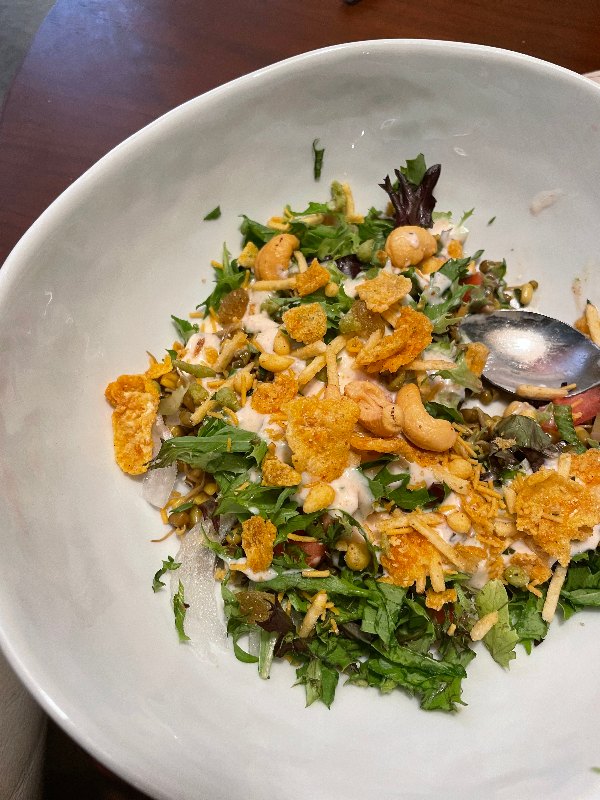
I'm making more of an effort to soak whole legumes regularly for sprouts. Here, I cooked whole moong bean sprouts lightly, and made a "bhel" of sorts by topping them with onion, tomato, chopped mixed greens, a bit of yogurt and cornflakes mixture- it made for a light, nutritious, and tasty summer dinner!

Sprouts bhel

There's a constant struggle of sorts in my home between the sugar-loving kids and my attempt to balance the "fun" foods with more wholesome meals and snacks that are not straight-up sugar-delivery devices.  My kids enjoy snacking on "flip yogurts"- the ones from Chobani and other brands sold in supermarkets- where you flip a small container of mix-ins into the yogurt and stir it together. They come, of course, in all sorts of enticing flavors.  

I've started making our own version at home by buying a tub of vanilla greek yogurt (I choose a lower sugar variety with a good amount of protein) and portioning it into small containers. And preparing tiny containers of mix-ins- a favorite is a combination of crushed Oreo cookies, crushed graham crackers, and chocolate chips. 

A batch of DIY flip yogurts

* * *

Media round up from this week:

  • Listened to a podcast episode that was highly recommended somewhere- The Mel Robbins Podcast "Let Them Theory" episode. It calls for a subtle but powerful mindset shift to stop controlling the behavior and choices of others, and to "let them" do whatever they want to do and focus your energy on your own life. 
  • Read Siddhartha by Herman Hesse. First published in 1922, and translated from German, this is a classic short novel. It is a story written very simply, in easy language- a parable of a young man and his search for meaning through different seasons of life. The simple language belies the deeper philosophical message. This is a book definitely worth reading once in your life. 
  • Reading What Color is Your Parachute? by Richard Bolles, the all-time bestselling guide for finding meaningful work and career success. My current project is ending soon and I'm trying to be more thoughtful and intentional about what sort of work I want to do next. Wish me luck! 
  • Started watching The Good Place, a sitcom on Netflix. A self-absorbed young woman arrives in the "good place" after her death, but her placement is an error, and she tried to becomes a better person in an effort to earn her place there. I'm only 3 episodes in and it is pretty good so far.
  • My son and I watched the comedy movie Matilda (1996) yesterday on Netflix- Danny DeVito's over the top adaptation of the Roald Dahl book. It is a classic. My son was slack-jawed at the tyrannical principal in the movie, and expressed relief that he goes to a better school than the one shown in this movie!

* * *

A moment of fitness: I've had a wonderful time testing our my "fitness chats" with a variety of people- and I want to thank everyone who gave me an hour of their time, and their valuable feedback. It is inspiring to hear of each person's unique relationship to fitness over their lifetime. In every post going forward, I'll try to talk about one aspect of fitness.

Today, I'm thinking of a very basic question: Why is there such a disconnect between the need for exercise, and the average person's ability/motivation to exercise? 80% of US adults do not meet exercise requirements. (What exactly are the exercise requirements for adults? More on that in my next post.) 

Is it really necessary to exercise? All available research overwhelmingly suggests that this is the case. There is no reasonable debate any more about whether exercise is important. It is quite simply the closest thing we have to a magic pill. 

But why do we need to exercise? It just seems so darn inconvenient and pointless! The whole problem is an evolutionary mismatch between how humans evolved, over 6 million years or so, and the modern environment that we now live in, which has only existed for a few hundred years (negligible in evolutionary terms), with time and labor saving appliances like washing machines and dishwashers really only being widely available for a few decades. For millions of years, humans had no choice but to be active for hunting and gathering and survival; our brains and bodies and behaviors evolved for regular and rigorous exercise. Our bodies also evolved to consume sugar and fat whenever it was available and to rest whenever we could to avoid spending extra calories when not required. 

But here we are in modern life where everything has been turned upside down. On one hand, our fridges and pantries are full of caloric food that our bodies can't get enough of. On the other hand, with transportation and appliances, there are few natural opportunities to exercise. And that is why we now have to resort to "artificial exertion" with gyms and weights and exercise regimens and fitness apps and organized sports. We are expected to do these while working long hours in mostly sedentary jobs, and, for many people, while raising kids and caring for elders without the benefits of a "village". It is a tough and somewhat perverse situation to be in, even though we recognize that modern life blesses us with many advantages. 

What does all of this mean for us? If you don't intrinsically love to exercise, that is understandable and normal and expected. The good news is that you are a human- intelligent and adaptable. You can use behavior change strategies to put an exercise habit into place. The world of exercise is so vast that you can find something that you enjoy that will fit into your life. And the best news of all- because humans have evolved to exercise, once you start doing it, you reap the benefits and grow to tolerate it/ like it/ love it! But it all starts with understanding and accepting that exercise is essential and that we have to hack our inner tendencies and find a way to include it in our life.

An interesting article on this subject: Humans Evolved to Exercise (Sci Am, 2019)

* * *

A doe has been leaving her newborn fawn in 
our backyard for several hours every day this week

Friday, July 05, 2024

I Ran the Peachtree Race, and Zucchini Pizza

They hand you a perfectly
ripe peach at the finish line!
Yesterday, I crossed off a big bucket list item- I joined over 40,000 people and ran in the famed Peachtree Road Race! It was a thrilling and unforgettable experience. This was the 55th running of the Peachtree- an iconic Fourth of July tradition in Atlanta, the biggest 10K race in the world, and a race that is infamous for three things- heat, humidity, and hills. 

The first two features were very apparent yesterday, with one of the warmest starts in recent history. (As for hills, my town where I train is so hilly that I somehow barely noticed the hills in the race.) It turned out to be the very first heat advisory day of this year. We stayed overnight at a hotel right at the start site. The wheelchair athletes took off at 6 AM, then the elite athletes at 7 AM, and then the rest of the runners in waves that set off every 5 minutes. My turn came around 8 AM and it was already sweltering- I felt like I was swimming in warm soup.

At the start line

The race is one big party, like you're in a parade going down main street. Streets are lined with cheering spectators hollering and holding signs. Sweet little kids hold up homemade posters saying "Touch the button to power up". I spotted inspirational quotes on perseverance, funny signs saying "You look hot" (accurate) and "That's a lot of hard work for a banana" (more like a lot of hard work for a peach and a T-shirt). 

Some spectators hand out treats, everything from pieces of banana to power drinks to mimosas and beer! Musicians and DJs hype up runners are at different points on the route. There were runners in themed costumes- I spotted Uncle Sam, Lady Liberty, King George V (top half of the costume worn with shorts lol), a bride in a veil. The whole spectacle is wonderfully distracting. The hardest part was weaving through throngs of people, many of whom are walking or jog-walking. 

Watching the early waves through
an 11th floor hotel window

Heat watch at the
Peachtree yesterday
For me, it is simply a dream come true to participate in a big sporting event for the first time in my life. My goal was to finish without puking or passing out. In fact, I felt fine throughout as I ran very conservatively with a "safety first" attitude, stopping at every single hydration station (thanks, volunteers), running through every fire hydrant sprinkler to cool off, and taking a few walking breaks. My secondary goal was to finish in under 75 minutes (1:15:00), and I finished in 1:13:16 with an average pace of 11:48 min/mile. This is entirely unimpressive in an objective sense, but for me personally to do <12 min miles over this distance in these crowded conditions with the heat index being what it was...I couldn't be happier or more surprised or grateful. 

The oldest race participant was a 99 year old woman named Betty! Watch this 3 minute video about her- what an inspiration.

In fact, the race was ended early ("black flag") because of weather conditions. Luckily, >95% of people had finished by then.

Southern hospitality is very apparent as you finish the race in Piedmont Park- we were greeted with cold water, perfectly ripe peaches, and troughs of soda. And the coveted finisher T-shirt. 

I don't think I will do this race again. Racing in the heat requires training in the heat and that's just not fun. But am I glad I did it once! 

This year's lovely T-shirt design

* * *

I've been trying some new recipes lately- here are two that had pleasing results. It is zucchini season and I tried something unusual- a zucchini pizza, recipe from Smitten Kitchen. First off, the pizza dough is wonderful for a pan pizza of any sort. And the topping of zucchini and cheese is lovely and seasonal. This reheats beautifully in a toaster oven or on a cast iron pan. Neither of my kids were fans but the grown ups all loved this take on pizza.

I found a bag of beautiful baby potatoes on sale and used them to make something I've wanted to try for years- hassleback hasselback potatoes. I took them to a friend's house; she admired them and asked if they're called "hassleback" because they're a hassle to make! In fact, they are much less of a hassle to make than I anticipated. Putting a pair of chopsticks under each potato makes it very easy to get the tops cut without going all the way through the potato. I simply roasted them with salt, pepper, and olive oil, and stuffed them with pesto. A lovely little treat.

* * *

Reading: A Short History of Tractors in Ukrainian, a 2005 novel by Marina Leywcka. This work of fiction is in the domestic fiction genre and was a very quick and engrossing read. The reviews keep describing it as hilarious and comical but I don't know...at best it is tragicomic. The book is written in first person by the younger of two Anglo-Ukrainian sisters; she is the peacetime baby and her older sister is the wartime baby. The family has endured harsh struggles and are survivors of tough political times before she came along. The sisters are at feud over- what else but- inheritance, but they put their feud aside when their 80-something widower father wants to marry a 30-something Ukrainian woman who they label as a golddigger. The book depicts the struggle of family relationships- an elderly dad asking his middle-aged daughters to mind their own business about his new relationship, even as he asks them for money to buy his girlfriend the fancy cars and stoves and vacuum cleaners that she demands. 

WatchingSchitt's Creek on Prime (Freevee). It is a great little sitcom about a filthy rich family that finds themselves penniless overnight, and living in a motel in a forgotten town that they bought as a joke years ago. I watched some episodes as in-flight entertainment some time ago and am happy to watch the whole series now. 

Tell me what you're up to, during this first week of July. 

Monday, June 24, 2024

Summer Solstice and Pool Days

Rainbow noodle salad
The summer solstice has come and gone; the days are long and hot and water play is on the menu. This year we have been enjoying pool afternoons for the first time in recent memory. Until last year, our son needed close supervision in the pool- it was more stressful than fun- and we preferred to go to splash pads as a safer alternative and run through water features and giant sprinklers. Now, after sustained swim lessons and a great swim coach, he is confident and competent in the water, and pool days are IN. We are able to lounge around, swim laps, and read while the kids play independently for hours, making trips to the concession stand for ice cream bars and packets of chips (according to my kids, chips purchased at the concession stand taste WAY better than the same brand of chips brought from home.) A dear friend and I spent nearly 4 hours yesterday alternating between wading in the pool and lounging on the deck, chatting happily while the kids had a blast and entertained each other- truly a joy of summer. My skin is burned to a crisp but I am so happy with the way the week ended.

The best thing I ate all week was a noodle salad with whole wheat spaghetti, full of shredded raw veggies, edamame, and a savory peanut sauce. With a mandoline, blender, and some patient knife work, it comes together quickly. This hearty salad keeps well in the fridge and is great to come home to, on those aforementioned pool days. 

I try not to use the oven too much during these months, but the hash brown casserole does get on the menu now and then. This one has broccoli in it and on the side. And also a veggie sausage patty on the side.


Eggplant is another great summer veggie, and I used a big globe eggplant to make eggplant kaap to serve with usal and yogurt rice with a chili pickle. A heavenly and homely meal. 


The wonderful thing about summer is the early sunrise. Tea and toast on the porch at sunrise is one of life's luxuries, while listening to the twitter of the birdies. The only kind of twitter worth engaging with, IMHO. This time the toast was topped with a tart cherry spread- a new product I found at Trader Joe's.
 

* * *

This weekend, our big project was to paint our daughter's room from an child-friendly aqua blue to a grown-up, sedate "marshmallow" white. The room had not been painted for a dozen years, so the makeover was overdue. Even painting a modest bedroom is quite labor intensive (especially going from a darker to a lighter color) and needed a couple of emergency trips to the home improvement store- but we all pitched in, including little bro wielding a roller, and got it done, all except the baseboards, anyway. It was quite the upper body workout. Funny enough, the Wordle on the morning we started painting predicted how the day would go. I use my morning Wordle the way other people use tarot cards.

Watching: I saw that the movie Annie (1982), based on the famous musical, was leaving Netflix on June 30, so I scrambled and watched it with my son. To my delight, he was very engaged and enjoyed it, and not only because it delayed his bedtime considerably! It is nice to see him willingly watching a non-animated film, and that too, an "old-timey" one- the movie is set in the 1930s. It is a fun and wholesome movie with familiar and catchy songs.

Every now and then, I watch an episode of the detective comedy-drama Remington Steele on Prime. It is full of mad capers and implausible situations, but the main draw for me is the trio that make up the main cast- Pierce Brosnan as Remington Steele has great chemistry with Stephanie Zimbalist as Laura Holt- her character is adorable, with sparkling intelligence making it one of those beauty and brains combinations. And their secretary is Mildred Krebs- played by Doris Roberts, who became more famous as the mom/grandmom in Raymond. This nostalgic show is a blast and an excellent mindless distraction if you're looking for one.

Reading: My reading life was exciting this week as I read a book called Beneath Divided Skies, a debut novel by Natasha Sharma. I bought this book a few weeks ago and I'm glad it finally got to my bedside table to be read and savored. I cannot write an objective review of this book as Natasha happens to be my close college friend! We met up in person after decades when I was in Pune last summer. I stayed in her home and was spoiled by her family's hospitality. 

Natasha has her own boutique software company but is truly a writer at heart. The story in this slim novel starts during the throes of India-Pakistan partition in the 1940s and catches up with the characters in the 1980s. Partition brought cruel horrors and upended millions of lives, and this book focuses on events endured by women- forced abductions, conversions, and marriages, and the efforts- first informal and then formally legalized- to repatriate the women, and the ethical conundrums of those efforts. It is a beautiful story, simply told, and while heart-rending, it is also life-affirming and heartwarming in the end. Bravo, Natasha, for highlighting a little known aspect of the history of partition! Find Natasha on Instagram and Facebook to learn more about the book and the wonderful things she is doing to promote writers and books in India. 

Other reading this week-  Dhruv Khullar's article in the New Yorker on longevity and what is sometimes called "healthspan"- years of healthy life. A good bit of the article is focused on the longevity guru Peter Attia who charges wealthy clients hefty fees to undertake expensive and extreme interventions...stuff that I have little patience for. But one sentence caught my eye, "...individual choices matter not because they are all-powerful but because they are the power that we have." Health is such a complex thing, and many health determinants- genetics, luck, environment, social factors, to name a few- are way outside an individual's control, but it is empowering to focus on the things that are within our control, the most important of which are thought to be these 4- stay as active as possible, eat as healthily as possible, get enough sleep, and nurture relationships.

I came across a poem by Naomi Shihab Nye that I loved- it made me chuckle, and it made me thoughtful. Read it if you like-  The Art of Disappearing

Pitcher plants at our
botanical garden

Tell me how your week is going!