Thursday, November 02, 2023

NaBloPoMo Day 2: Mind

We're two months away from the end of 2023 but I am confident that this book will be my favorite read of the year: How to Change Your Mind- Michael Pollan. It came out 5 years ago to rave reviews and has been on my TBR (to be read) list ever since. The subtitle of the book is What the New Science of Psychedelics Teaches Us About Consciousness, Dying, Addiction, Depression, and Transcendence.

It is fortuitous that I waited all this time to read it, because when I did pick it up, it was at the right time and the book just hit me differently than it would have before. I have thought more about "consciousness" this year than in any of the preceding 4 decades. When I was in grad school for biology, there was a standing joke that whenever the big shots in the field got their Nobel prizes, they would stop working on whatever they used to work on, and start working on consciousness. Basically consciousness had that "woo-woo" reputation and with good reason, because it is one of the biggest (if not the biggest) mysteries of the universe, very complicated to study objectively, and also a field rife with charlatans of different stripes. Now, I'm reading different books, thinking about consciousness and the mind, and interested in learning more the way I never was before. 

How to Change Your Mind is a tour de force of narrative nonfiction by Michael Pollan. I used to think of psychedelic drugs in the way most people do, my immediate associations being rave parties and '60s hippies with those iconic psychedelic colors and patterns. Well, Pollan did change my mind and I now have a less superficial understanding of this. Pollan starts off the book by covering the history of psychedelic drugs and why they are experiencing a renaissance now. 

Then, in an amazing first-person narrative chapter called "travelogue" he describes journeying underground (because these drugs are illegal in the US) to find underground guides or therapists who work with a variety of psychedelic substances in a carefully prescribed manner, and trying LSD, Psilocybin, and 5-MeO-DMT or the Toad for himself. (It struck me that there is a strong privilege in being able to try illegal drugs without repercussions, and write a best-selling book about the experience, even as tens of thousands of predominantly poor and minority people are behind bars for low-level non-violent drug offenses in the US).

My absolute favorite chapter in this book was about the neuroscience of psychedelics. I am going to say that it is the best chapter of any book I have read, ever. This is where he discusses the neuroscience of consciousness, which is that unmistakeable sense we have that we are, or possess, a self that has experiences. Most scientists believe that consciousness is a product of brains but some suggest that it could be a property of the universe or a fundamental building block of reality, like gravity. 

How can the ingestion of a compound/molecule created by a mushroom/toad/chemist cause a novel state of consciousness? All these three compounds are tryptamines and mimic a tryptamine that our body produces naturally, serotonin or 5-hydroxytryptamine (5-HT). The classical psychedelics have a strong affinity for the 5-HT2A receptor and that is how they unlock the door to the mind. Anesthetics disrupt normal consciousness by shutting it down, while psychedelics disrupt normal waking consciousness in ways that may force its fundamental properties into view. 

What do we know about physical structures in the brain related to this? The big player is the default mode network (DMN), a critical central hub which appears to be the brain's orchestra conductor. It is called the “default mode” because it lights up with activity when we have no mental tasks to perform and our minds go to wander- this may be where our stream of consciousness flows and it consumes a disproportionate share of the brain’s energy. The DMN plays a role in creating mental constructs, including the self or ego, and it is responsible for autobiographical memory or the story of who we are. When activity in the DMN falls off precipitously, the ego temporarily vanishes and the usual boundaries between self and world, subject and object melt away. The psychedelic experience of non-duality suggests that consciousness survives the disappearance of the self despite what we and it think. 

Psychedelics can quiet the DMN, loosen the ego’s grip on the mind machinery, and increase entropy in the brain, allowing a thousand mental states to bloom- many bizarre and senseless but some that can be revelatory or transformative. Finally, the link between psychedelics and meditation is that both of those achieve the same thing (only the latter is legal, free, and available to everyone.) Deactivating the DMN can be achieved through psychedelics and meditation, holotropic breathwork, sensory deprivation, fasting, prayer, extreme sports, near death experiences and so on. 
The final chapters of the book talk about the use of psychedelics in helping terminally ill patients lose their fear of dying, and in the treatment of addiction and depression. But psychedelic treatment is not just for the sick, it can be used for the betterment of well people. The reason to focus on meditation and not rush off to find psychedelics is that the effects of psychedelics fade away but can be recaptured in meditation. All in all, this is a fascinating, must-read book. 

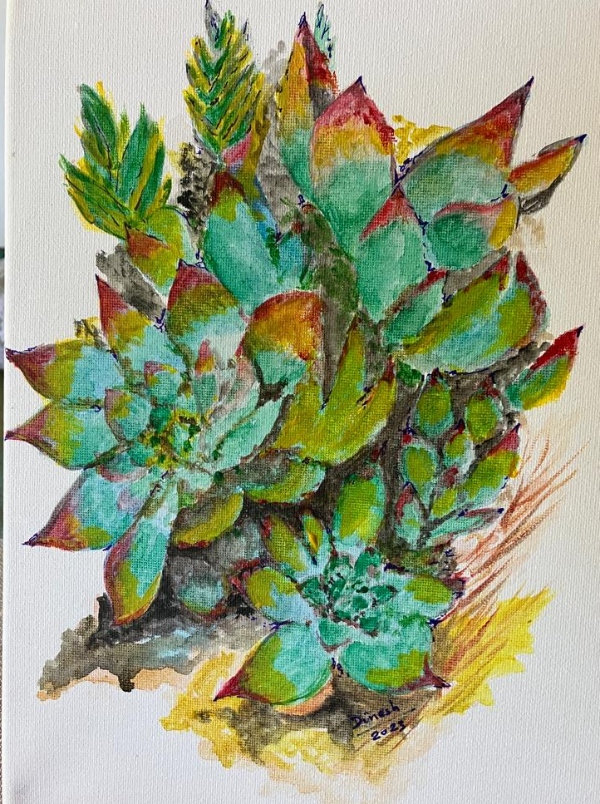
"Succulents"
Painting by my Dad

One more on this subject- Based on a recommendation I saw on one of the book loving websites I frequent, I picked up this book from the library: The Happiness Trap- Russ Harris. This book is an easy to understand introduction to Acceptance And Commitment Therapy (ACT), an evidence-based model of behavior change. 

As I've said before, different books and models converge on the same small set of principles, and here too, the advice from this book boils down to not identifying with our thoughts and emotions, which come and go endlessly, but instead pay attention to the present moment and start understanding our "observing self". Here are some sample quotes from this book. 
  • Like a lion placed in a paper cage, human beings are generally most trapped by the illusions of their own mind. 
  • Evolution has shaped our brains so that we are hardwired to suffer psychologically: to compare, evaluate and criticize ourselves, to focus on what we are lacking, to become rapidly dissatisfied and imagine frightening scenarios.
  • We have little control over our thoughts and feelings but we have a huge amount of control over our actions.
  • Your mind will never stop telling you unpleasant stories because that’s just what minds do, but you can make dramatic improvements and learn to unhook yourself.
  • The thinking self gets bored because boredom is a thought process, a story about how life could be more interesting.
  • The observing self is incapable of boredom and registers everything with openness and interest.
  • Our society places a lot of emphasis on thinking but there is more to you than your thoughts.
  • Life gives most to those who make the most of what life gives.
  • Put your life's energy into action and attention because those are the two things you can control.
See you tomorrow for a discussion of something much less lofty than consciousness- Snacks

Wednesday, November 01, 2023

NaBloPoMo 2023 Day 1: Pause

Happy November! NaBloPoMo, or National Blog Posting Month, is a month-long writing exercise that occurs each November. The concept is as simple as this: bloggers post something every day. I've had severe writer's block/ inertia with blogging lately. I frequently write blog posts in my head but never get around to typing them out. On a whim, I've decided to blog every day this month. Posts may be long or short. They may be centered around food on some days, but are more likely to be pointless, rambling musings. Consider yourself warned. 

And because there are no NaBloPoMo police, I'll take days off blogging if I have to, for instance, if our sweet Dunkie's condition worsens. It is hard to tell if we have days or weeks or months left with him. We had a hospice vet come by to visit him last week, but Dunkie is still continuing to do well and is napping and snoring softly near me as I write this! 

In my first post of 2023, I jotted down a few goals for the year, and a thematic word of the year- "Pause". The word aligned well with one of my goals, which was to start meditating regularly. 

As of today, we have only 61 days left in 2023. How did I do with these goals of pausing and meditating? Well, meditation and mindfulness are the work of a lifetime and not a goal to be reasonably achieved in a year, not by mere mortals anyway. I don't always PAUSE but I sometimes do. I don't meditate everyday but I sometimes do. It has been a gratifying journey so far in that I have learned so much in a few months- I am starting to understand and appreciate the concepts. Internalizing them and living them will be the journey of the rest of my life.

On the subject of meditation/mindfulness, there are an overwhelming number of books, blogs, podcasts, programs, retreats, guides, leaders, gurus, apps out there, and they more or less converge on similar concepts. It is really a matter of who you happen to come across and who resonates with you. These are ancient concepts that are being packaged and repackaged in different ways, and increasingly being studied and evaluated in different settings. 

I picked up this book from the library a few months ago: Waking Up by Sam Harris. The reason it appealed to me was the subtitle- A Guide to Spirituality Without Religion. Many people conflate being spiritual with being religious and I quite enjoyed this frankly atheistic point of view. And as with most books in this genre, there were chapters that appealed to me and chapters that did not. Here are some quotes I jotted down, to give you a flavor of the book:

  • Our minds are all we have. They are all we have ever had and all we can offer others.
  • How we pay attention to the present moment largely determines the character of our experience and therefore the quality of our lives.
  • We seem to spend most of our life in a neurotic trance as we shop, gossip, argue, and ruminate our way to the grave. But an alternative exists.
  • It is always "now".
  • Learning to meditate is like acquiring any other skill. With practice, the difference between it and ordinary thinking will become increasingly clear.
  • As a matter of your experience, you are not a body of atoms, molecules, and cells- you are consciousness and its ever-changing contents.
  • The goal of meditation is to uncover a form of well-being that is inherent to the nature of our minds.
  • A middle path exists between making religion out of spiritual life and having no spiritual life at all.
I ended up downloading the Waking Up app- one of the very few apps that I've ever purchased in my life. (There are many good, free meditation apps out there too.) It has been very useful for me. I worked my way through the introductory course, and now try (ahem) to do the daily meditations. I really enjoy listening to the theory sections with short and long audio lectures. 

(It is very characteristic of me that I lean towards learning concepts rather than practicing them. Unfortunately meditation is not a thinking activity but a doing one, or rather a not-doing one, so this is a very uphill battle for me.)

The book I picked up next was Meditation for Fidgety Skeptics by Dan Harris. I liked this one less than that first book, but still took away a few things, like these-

  • The word “meditation” is a bit like the word “sports”; there are hundreds of varieties.
  • You are breaking a lifetime’s habit of walking around in a fog of rumination and projection, and you are actually focusing on what’s happening right now.
  • Getting lost and starting over is not failing at meditation, it is succeeding.
  • Thinking is a wonderful servant but a terrible master.
  • The internal narrator/ego/monkey mind is insatiable and dissatisfied. How many desserts, movies, and vacations have you enjoyed and are you done yet?
More on this subject tomorrow, including my thoughts on the best book I've read all year. Do you meditate or, um,  think about meditating? How is that going for you?

Friday, September 15, 2023

Eggless Tres Leches Cake, and Backyard Wonders

Tres Leches cake is a favorite in our home. The sponge soaked in sweet milk, tinged with cinnamon, and with a cream topping and fresh fruit makes it pretty much irresistible as a dessert option. I've posted before when I made the typical recipe that features lots of eggs. Last weekend, friends invited us over for supper, and said they would serve Mexican-inspired bowls. A tres leches cake seemed to fit the theme, and I decided to try a new recipe for an eggless variation

I used this recipe. The day before, I mixed up the cake batter and baked it, simple as can be. While the cake was baking, I mixed up the three milks- sweetened condensed milk (a dairy version), coconut milk, and almond milk. I soaked the warm cake and refrigerated it overnight. A few hours before serving, I made some whipped cream in the stand mixer, and my daughter and her friends helped to frost the cake and decorate it with strawberries and mango puree. For a cake that looks and tastes quite special, it is dead easy to put together.

The cake was a hit! With a large 9 x 13 cake, I was sure we would have leftovers for days. Gentle reader, we did not. I came home with an empty dish. The cake was not too sweet, not too rich, with a pudding texture, and not eggy at all, obviously. It was gratifying to see everyone enjoy the cake, and I'll definitely make this version again- but with some modifications. 

You see, no matter how well-received the cake was, there were flaws. The biggest problem was that even after an overnight sit in the fridge, the milk did not fully soak into the cake. The cake sat pooled in sauce. The cake was quite dense and not as spongy as expected. Things I will watch out for next time: (a) Don't over-mix the batter, (b) Put the batter in the oven right after mixing, (c) Cut the top crust off the cake after baking to allow milk to soak in, (d) Be more aggressive about poking holes in the cake before adding milk. 

Still, this was a great cake for a family dinner on a late summer evening. 


Here is another dessert that we- especially my daughter- enjoyed over the last month. Falooda, the refreshing Persian-Indian rose sundae. Our 2 minute version is made simply with soaked basil seeds, milk, rose syrup, and vanilla ice cream. 


*** Backyard Wonders ***


This summer, we got some renovations done on our screened porch and replaced the deck at the back of the house. The deck was falling apart and we barely even used it in the decade we've lived here. In this remodel, we had a staircase built from the porch to the deck and that has changed everything- the easy access means that we use it every day now. The porch, deck, and backyard is bringing me much joy as I enjoy the outdoors on a daily basis. There is nothing better than sitting on the deck in the dappled sunshine and watching squirrels scampering about. You hear owls. You see birds, deer...in the middle of a busy town, it is a haven.

Our Dunkie boy loves the deck even more than I do. This sweet and beloved dog is living on borrowed time. He has outlived- by several months- what the oncology vet predicted. His mast cell tumor (you can see it in his armpit in the pic below) is growing fast. We are taking it one day at a time. So far, he is a fighter and enjoying life as much as ever- taking long walks every day, sitting on the deck in the sun, and in the porch, enjoying his food and treats, taking his daily pills (steroid and anti-histamine) in a gob of peanut butter. We are watching his quality of life closely. 


Can you spot the deer visitor?

***
I've been reading a lot lately. Two interesting reads were both eerily atmospheric. The first was a novella The Langoliers in the collection Four Past Midnight by Stephen King, set in a airplane on a cross-country red-eye flight. The second was an Agatha Christie book that I had not read before, Endless Night

What are you reading, cooking, eating, and doing these days? 

Saturday, August 12, 2023

A Raw Taco Filling, and More Books

Tacos, quesadillas, and enchiladas- or our versions of them, anyway- are staples in our dinner rotation, and I am always looking for variations to try. One recipe that I've come across often is a plant-based taco filling with walnuts. It sounded intriguing, and last week I had a big bag of walnuts on hand and decided to give it a try. 

This was the recipe I chose, based on the fact that it only calls for 5-6 ingredients, all of which I had on hand. It was shockingly easy. Everything went into a food processor and was pulsed for a few seconds into a coarse mixture. It smelled savory and delicious and I couldn't help sneaking a bite- wow! I've never enjoyed eating raw cauliflower florets but here it came all together so well. 

Then the recipe called for baking the mixture. I did that, and we enjoyed the filling in crispy taco shells with coleslaw. It tasted great but we thought it was a bit dry. 


I couldn't stop thinking of my bite of the taco mixture before I baked it. It was great just as a raw mixture and the oven seemed to dry it out. So I made it again, for a farewell party for dear friends who are moving away to another city, and left it unbaked, and served it as DIY raw tacos with romaine lettuce leaves and guacamole. It was a hit! 

Raw tacos: Romaine lettuce, guacamole, 
walnut-cauli-chipotle filling

Vegetarian taco filling (based on this recipe)

Pulse the following ingredients in a food processor until evenly ground:

  • Cauliflower florets, 3 cups (1/2 medium head)
  • 2 cups walnuts
  • 2 chipotle peppers in adobo sauce
  • 1 clove garlic
  • Juice of 1/2 lime
  • 1 tablespoon chili powder
  • 1 teaspoon cumin
  • 1 teaspoon salt
I can see myself making a batch of this filling and using it in burritos, bowls and nachos- so many possibilities! 

* * *

Along with the raw tacos, I made summer rolls and peanut sauce for the party. These are fun to make and even more fun to eat, and colorful and refreshing on a hot summer day. 

Summer rolls with tofu, herbs, and veggies

* * * 

Here's what I have been reading in the last two weeks-

Grit: The Power of Passion and Perseverance by Angela Duckworth (2016): Much has been said about grit and the growth mindset in recent years, so when I spotted this book in a local Little Free Library, I picked it up. It was an interesting read and I did take away some messages, such as why effort beats talent, why extracurricular activities (chosen by the child based on their interest) are important, and how any job can be crafted to be more purposeful. 

Jurassic Park by Michael Crichton (1990): The movie is a classic, of course, and the book is a really fun read as well, an engrossing dramatic adventure. Now I want to watch the movie again. 

A Monster Calls by Patrick Ness (2011): What a beautiful, deep, touching story this is. 13 year old Conor is facing huge challenges in his life, and a monster walks in to help him grapple with it. I highly recommend this slim novel. 

New babies of 2023:
Twin fawns are back in our yard

How is August going for you? What are you eating and reading and doing these days? 

Sunday, July 30, 2023

Austin, Hibiscus Iced Tea, and What I'm Reading

Our summer is coming to a close this week. Summer, the season, is still in full swing, as the blistering temperatures will attest to. But summer, the break, is almost over and a new school year is upon us. I'm blessedly done with all summer travel, which for a homebody like me, gets to be much too much. 

Last week we were in Texas for a few days, including a 3 day getaway to Austin. What a cool city it is. I don't mean that literally at all- it was 105F/40.5C each day we were there. We spend a great time of our time in water of various kinds. There was the backyard pool of the vacation rental, lovely for dips in the morning and evening. There was one evening at an indoor waterpark- where each member of the family, from tweens to seniors, found something to enjoy, from the giant slides to the lazy river, wave pool, and hot tub. 

But my very favorite thing in Austin- water related or otherwise- was swimming at the Barton Springs pool. It is spectacularly set in the heart of the city. Dipping my toes into the cold water, I thought it impossible that I could actually swim in there, but after the first frigid shock, the water was refreshing and I did not want to leave. There's something exhilarating about swimming in 70 degrees water when the air is 105 degrees. 

We did a couple of touristy things- like watching the most famous bats in America fly out of Congress Bridge, and visiting the museum of ice cream- really just a small, overpriced theme park, but with unlimited ice cream and some unique photo opportunities., including a swimming pool full of oversized plastic sprinkles.

Vacation rental backyard

Barton Springs in Austin

Waiting under Congress Bridge for the bat flight

Reveling in (fake) sprinkles

Another very fun I did in Texas- I got to meet the Shoba of Anubhavati! It was a very brief hello but it is always special to meet a fellow blogger in person. She is a friend of my sister's (small world, right?) and my sister describes her and her husband as simple, sweet, and helpful. That about sums it all- she is lovely. 

* * *

While perusing the aisles of a Mexican supermarket recently, I impulse-purchased a bag of dried hibiscus flowers. I've enjoyed hibiscus tea in the past a couple of times- an iced version served at a neighbor's football party, and a warm, irresistibly spiced version sold by a Jamaican vendor at the Farmers' Market- but had never thought of making it myself. 

Summer 2023 needed a signature drink, and this was IT! I made the tea once, everyone in the family was wowed by it, and I proceeded to make it several more times. Sweet and tart, served on ice, this is one refreshing drink. A pitcher of hibiscus tea will hold in the fridge for a few days. 

Iced Hibiscus Tea

This was the recipe I used, and it could not be simpler. 

Bring to a boil:

  • 5 cups water
  • 10 dried hibiscus flowers (if flowers are in pieces, approximately 1/3 cup)
  • 3/4 cup sugar 
Simmer for 20 minutes or so. Cool and strain, discarding the flowers. Serve on ice. Dilute with additional water if desired.

* * *

My favorite recent read was The Music Room by Namita Devidayal (published in 2007). This was a wonderful book for many reasons. It was recommended and gifted to me by a dear college friend. It is set in locales- South Bombay, Kolhapur, the Western suburbs of Bombay- that are uncannily the places that I have lived in during the first two decades of my life, making the book very relatable. It transported me into a different world- that of Indian classical music, and the teacher-student (guru-shishya) tradition that keeps this world going. I come from a very musical family but am sadly not musical myself, and I came away with awe and understanding (and a strong urge to search for ragas on YouTube). I highly recommend this book to anyone interested in memoirs, or music, or India. 

On vacation, I read another memoir, a graphic one called Talking to Strangers: A Memoir of My Escape from a Cult by Marianne Boucher (2020). This was a quick read, fascinating and alarming. A young adult travels on her own to dance auditions, and a chance meeting on a public beach leads to her abandoning all plans and joining a group of strangers in a cult. Her dedicated mother helps her escape a few months later.

While my parents were visiting us last month, they read stacks of books from the public library. One that my mother particularly enjoyed, and that I ended up reading too, was The Power of Regret by Daniel Pink (2022). The author objects to the "No regrets" mindset and explains that this is a nonsensical doctrine- regrets in fact make us human and make us better. Research shows that humans all over the world tend to have regrets that fall into 4 core baskets- foundational regrets (regrets related to education, finance, health), boldness regrets (over time we are much more likely to regret the chances we didn't take than the chances we did), moral regrets (morally dubious decisions gnaw at us), and connection regrets (relationships that fracture or fray, or never develop). The core regrets represent the human need for stability, growth, goodness, and love. The book has chapters on dealing with regret, and anticipating regret. It is a pretty good read with some interesting anecdotes.

Funnily, this book on regrets fed right into a novel that I read right after- The Midnight Library by Matt Haig (2020). I breezed through this novel and it was a fun, comforting read. The premise is delicious. Most of us, if not all of us, have some regrets in life- choices made, paths not taken, and fantasies unfulfilled. What would happen if our lives had taken a different turn? The protagonist of this novel gets a chance to undo each of her regrets and experience what life would have been like with different choices.  

Sometimes you just want a juicy mystery to sink your teeth into, and one such book was The Kind Worth Killing by Peter Swanson (2015) that I finished reading just yesterday. This is no cozy mystery, it is a wicked and fast-paced psychological thriller, and a good summer read. The twists and turns kept me interested until the last page.

What are you reading, eating, and drinking this summer?

Thursday, June 29, 2023

Pics from a Trip to India

From late May to mid-June, our family of four visited India for nearly three weeks. It was my first trip back in 9 years. It was my son's first trip and my daughter's second trip to India- but she was under 3 years old the last time we visited, so it was as good as being her first one. The only thing she remembers from our 2014 trip is sitting on her grandmother's couch and watching Chhota Bheem

Here are some scattered food-centric thoughts from our trip, with a few pictures, and in no particular order. 

1. In terms of weather, May is not the best month to visit Maharashtra, on the west coast of India. The month was chosen for us by scheduling constraints- the kids have almost 10 weeks off from school, and it is perhaps better to go at the tail end of summer than during the height of the monsoon. 

For my daughter, what made up for the sweltering heat and humidity were the mangoes. Fresh, in-season mangoes were a revelation for her. She watched as mangoes were taken down from her grandparents' backyard mango tree, and then set down in straw to ripen to perfection. 

These alphonso mangoes are buttery, smooth, and sweet as can be. Other than fresh mangoes, she enjoyed mango ice cream and milkshakes and pickles and chutneys. (Her brother refuses to eat mangoes; he says they taste like soap to him.)

Fresh mangoes- cut and eaten
on the hour, every hour

Raw mangoes being bedded down in
straw to ripen naturally

2. Mangoes were not the only gifts of nature that the kids got to enjoy. The very first day we arrived, we bought these lychees from one of the many wonderful street vendors. As he promised, they were sweet and juicy. (We do get lychees here, rarely, at the Asian market). The kids also got to taste black-purple jamun or jambool, and tender coconut water from a vendor at the beach. They were not big fans of the mildly astringent taste of jambool. My daughter was a little weirded out by the texture and slightly briny flavor of slippery coconut jelly!

Fresh lychees

3. Eating in- We got to eat incredible home-cooked meals from the kitchens of our parents and aunts. At my mother in law's home, we ate idlis and dosas with fresh chutney, and many wholesome Southern Indian lunches. 

My parents have a wonderful lady who comes in every morning for a couple of hours and prepares magical meals. Among the dishes she cooked for us were thalipeeth, bhakri with jackfruit seed curry, misal pav, upma, and the breakfast you see below. My mother herself made gobi manchurian, which my kids loved, and lots of buttery toasts for my son who would eat little else! 

My aunt likewise treated us to homemade pohe, pateta par eeda, ragda patties, and a plethora of interesting store-bought snacks- like vada pav flavored khakra. She introduced my daughter to those jim-jam biscuits (filled cookies with a jam center) that I used to love as a child, and they were an instant hit.

A home-cooked breakfast of spinach puri, veg curry,
cucumber salad, and raw mango chutney

4. Eating out- Over the three weeks, we certainly ate out a whole lot. We ate all the must-haves of Maharashtra- pav bhaji, batata vada, Naturals ice cream, Frankies. Plus the usual Indian standards- Indo Chinese food and Punjabi food.

A highlight was meeting a friend for breakfast at 7:30 AM at the iconic Cafe Madras in Matunga. There was a crowd waiting outside the restaurant the whole time. It is mega popular and an institution. Pictured below is their plate of upma with mixture- so soft and tasty! We also tried ragi dosa, neer dosa, set dosa, and several cups of filter coffee with jaggery.

Another memorable meal was at Panhala, a hill fort near Kolhapur where we stayed overnight. My aunt, cousin, dad, and I slipped out to eat at a small family-run eatery- just a stall with plastic tables and chairs around it- that sold pithale-bhakri and bharli vangi, a rich eggplant curry. It was a simple, piping hot, and sublime meal. There was yogurt on the side, and a fiery condiment called thecha. 

I spent less than 24 hours in Pune but got to see many loved ones. It was fantastic spending time with my college friend after 24 years and getting to meet her sweet family. For breakfast, she and her husband took me out to a place that served nine different types of pohe! What fun! I had the Indore pohe after lots of deliberation. With the pohe they got me some wonderful (and very hygienically pressed) sugarcane juice. I was beyond spoiled. 

Upma plate at Cafe Madras
 in Kings Circle, Matunga

Pav bhaji- excellent, but needs more pav
and less onions! 

Thecha- a green chili paste condiment
in the making

Medu vadas for breakfast picked up
from a small Udipi place

Indori pohe

5. One more memorable meal- My mother organized a lunch at home for a dozen neighborhood aunties who all knew me growing up. It was great to see them all, and they all look decades younger and vibrant as ever. She got the lunch catered and it was a beautiful, traditional puranpoli thali

Clockwise from the noon position you see pictured- kaat (a thin, spicy curry), wedge of lemon, masale bhaat (a perfectly spiced pilaf), puranpoli (bread with a sweet lentil stuffing), cilantro chutney, vaatli dal (ground lentils), potato bhaaji (a dry curry), koshimbir (salad of cucumber and tomatoes garnished with crushed peanuts).

All in all, over this trip, we were treated to lots of good food, all very tasty, but quite different from the way I usually eat. There was a lot more fried food, lot more sugar, and a lot fewer vegetables than I am used to. I enjoyed it thoroughly and I am also thrilled to be back in my own kitchen.

The puranpoli thali, described above

Sweet syrupy paan after lunch

6. Animals: Right upon landing, my creature-loving kids were immediately intrigued by the stray cats and dogs, and peppered us with questions about them. My son summed up his feelings by saying that stray animals make him both happy and sad. He is happy to encounter them and watch them, but sad that they have no homes and no family. We bought some dog treats and stashed them in my purse to hand out to dogs. 

We noticed people caring for the animals, and most looked quite healthy and well-fed. There were not as many strays as I remember from the past. I saw several animals with their ears notched/tipped, which I understand is the universal sign for a stray who has been vaccinated and sterilized. I told the kids that although the strays don't have an easy life, there are good people everywhere, and clearly there are folks who care for them. 

Apart from dogs and cats, my kids were intrigued by the birds- mynahs and parrots, and pigeons and crows. A crow stations itself outside my aunt's second floor window and came to the windowsill every time we sat down to a meal, asking for its share. In Vashi, there were beautiful water birds on the lake. My dad took the kids to the grounds of the local university to see wild peacocks- a spectacular sight and they screech loudly! When we visited the hill fort town of Panhala near Kolhapur, the kids had their most memorable wild animal encounter when they came face to face with langurs.

A stray cat has adopted my parents and shows up
every morning in their yard for food

The langur outside our hotel window,
making a play for a child's snack

7. Nature: We stayed close to our families' homes and maximized time with people instead of getting out of town to beach towns or hill stations. But we enjoyed walking around to nearby parks and playgrounds wherever we stayed. My parents have a tiny, sweet, and beautifully cared for garden around their house, and it was lovely to eat meals there under the shade of the mighty mango tree. This tree was planted by my grandfather, and now his great-granddaughter is enjoying the fruit. 

We visited the hill fort town of Panhala for a night, and the views of the valley were spectacular. My dad, daughter, and I did an early morning hike through the hills to a park called Tabak Udyan. I remember going to this park on field trips as an elementary school kid, and it was fun to show my daughter the places where I sat in a circle with my little friends and ate out of my tiffin box.

Near my aunt's apartment in Juhu, Andheri, where I lived for several years in the 90s, I was overjoyed to see that a swampy piece of land is now a beautiful, restful, garden. The streets are lined with mural art and the mangroves are cordoned off and preserved. There are trash bins everywhere. 

We went to a small neighborhood beach at Juhu. A cyclone was making its way up the coast and the tide was high and furious. We were allowed to stay on the beach for only a few minutes and then the lifeguard shooed us away because conditions were becoming dangerous. Still, I am glad we got to dip our feet in the Arabian sea! It was sad to see how much plastic trash was washed up to the beach by the waves. Our oceans are clearly choking with waste.

My parents' backyard

A view of the valley in Panhala

Tabak Udyan with its famous
embracing trees

Hibiscus schizopetalus, 
a super decorative hibiscus


A small beach near Juhu, Western Mumbai

* * *

Visiting after nine long years, the highlight of the trip for me was catching up with people- relatives, friends, neighbors. It was good to see their smiling faces and hear all the interesting things they are doing with their lives. I saw several school and college friends that I haven't seen for over two decades. I also met up a longtime blog reader, H, and had a lovely cuppa and chat with her- it was like meeting an old friend even though we were meeting for the first time. 

The weather being what it was, we sheltered indoors and did not go out as much as I would have liked to be. The kids spent quite a bit of their time doing stuff that isn't too different from what they do here, and I made my peace with that. They went to see the new Spiderman movie at an IMAX theatre (first day, first show, which was exciting). Many afternoons, we ended up in the mall and the kids played in the arcade of all places. They ate pizza and soda in the food court. My son bought lego and pokemon cards. Oh well :) 

My daughter enjoyed Indian stuff a lot, the little things that she doesn't get in her normal life, like dressing in Indian clothing and jewelry for a photo shoot, and wearing jasmine garlands in her hair. She made beaded jewelry and read Enid Blyton books. We took her to South Mumbai to Jehangir art gallery and a quick visit to the Gateway of India and Colaba Causeway. She was unfazed by the traffic and crowds and eager to see everything. 

In the taxi on the way to the airport, both kids told me how much they enjoyed the trip to India. I am beyond grateful that they had many happy moments with relatives and friends, that they each found things to enjoy, that they tasted new things, and that they stayed healthy and happy over the trip (I was the only one who caught a stomach bug, and it thankfully only lasted a day.) This is not an easy trip to make with long, cramped flights, endless layovers, bickering kids, and crushing jet lag, but overall it all went better than I had imagined. 

As I was telling my daughter, she and her brother are Americans, but with access to this whole other complex and vibrant culture through their ethnicity and their parents' origin. It is theirs to tap into if and when they want to, and to whatever extent they like, for travel and discovery, for study and work. 

* * *
While we were away on this long trip, our sweet boy Duncan went to stay with a pet-sitter who owns a farmhouse with 2 horses, an elderly goat, 2 chickens, 2 dogs, and 2 cats, and several acres for the animals to roam around in. Duncan spent his days wrestling with the dogs, sunning himself in the fields, and napping indoors. He had his own vacation and came home so tired and happy! 

Back in his own yard

Big smiles

How is your summer going? 

Thursday, April 20, 2023

12 Ways to Start Cooking Indian Food

This post was motivated by an email I received recently by a reader who saw my Madras lentils post and requested a similar copycat recipe for the Tasty Bite yellow lentils. She explained that her spouse is from India and she wants to learn how to cook Indian cook, even though, she said, she's not much of a cook in the first place. 

This email exchange got me thinking about how daunting it can be for someone to learn how to cook a whole new cuisine. Especially one that is as complex as Indian cuisine, with its legion regional variations, ingredients and techniques. 

People new to Indian cooking may be at different starting points. Some may be familiar with Indian food and flavors because they grew up in India, or grew up outside India but in a family with Indian ancestry. Others may have a Indian partner or friend, or may have simply encountered Indian food in restaurants or the home of friends and be inspired to create it themselves. 

I believe in baby steps. You do one small thing, build confidence and go from there, collecting skills and spices, recipes and ingredients along the way. And so - where to begin? 

You need to start somewhere and here I present 12 ways to get started. One or two of these will likely resonate with just about every aspiring Indian cook. 

1. Start with a no-cook recipe: One way to start cooking Indian food is by not cooking at all! Do some simple chopping and assembly instead. 

    • Make a raita or yogurt salad by mixing chopped tomatoes and cucumbers and shredded carrots with plain yogurt. Season with salt and garnish with minced cilantro and/ or mint. 
    • Make chutney sandwiches. Buy mint chutney from an Indian store or zhoug sauce from Trader Joe's. Assemble sandwiches with buttered bread spread with the chutney and loaded with thinly sliced cucumbers and tomatoes. A shower of salt and pepper brings the flavors together. 
2. Start with a recipe with fewer than 5 ingredients: Sometimes a long list of ingredients is intimidating. 
    • Peas pulao is a simple side dish that needs only a handful of ingredients. Rice + Cumin seeds + Salt + Frozen peas + Water -> Cook in rice cooker or on stove top = Peas pulao
    • For inspiration, here's a round-up of the Less is More food blog event, featuring dozens of Indian recipes that call for 5 or fewer ingredients.
3. Start with a favorite packaged food: Lentil based packaged meals are very easy to recreate at home. If you're buying Tasty bite lentil packs on repeat, consider making it at home using a recipe that uses similar ingredients. Looking at the ingredient list from the package, here's how I would make this dish
    • Soak 2 cups split peas for 4-8 hours. You could use split yellow peas from American supermarkets or buy chana dal or toor dal from Indian grocery stores or online. They will cook faster when soaked. If you don't have time, just rinse them. 
      • Heat 1 tbsp. sunflower oil (or any neutral oil)
        • When oil is hot, add 1 tsp. each mustard seeds and cumin seeds (seeds will pop)
          • Add 2 tsp. salt (or to taste), 1 tsp. each turmeric and ground red chili peppers, and 1-2 tbsp. minced garlic and fry for a minute
            • Add 2-3 tbsp. tomato paste
              • Add soaked split peas and 4 cups water (or more, water should be a couple inches above the level of the peas)
                • Cook until lentils are very tender (falling apart)
                    • An instant pot or pressure cooker makes it really fast. Cooking on the stove top will also work, of course.
                    • Ingredients that are not listed could make the dal more flavorful. You could add onion and ginger in step 4 for added flavor. 
                    • After cooking, I highly suggest tasting and adding more salt as needed. 
                    • Add lemon/lime juice and cilantro and a knob of butter or bit of ghee (or vegan butter or coconut oil if vegan) to finish off the dal. 
                4. Start with a favorite restaurant dish: If you find yourself hitting the Indian buffet all too often, try a restaurant dish that is easy to recreate at home. Aloo gobi - a stir fry of potatoes and cauliflower- would be my recommendation for an easy first dish to make. 

                5. Start with a packaged spice mix: In my spice cabinet inventory post, I noted that how a well-made spice mix is a wonderful tool, allowing you to capture the right flavor that just "makes" the dish. Try buying a tandoori masala to make some tofu tikkas or paneer tikkas at home. Or a rasam mix that you add to tomatoes and yellow lentils to make a wonderful rasam or spicy lentil soup.

                6. Start with what you know: If you have established talents in the kitchen, extend them to Indian cooking. For instance, a bread baker could try making some naan at home. If you're a master griller, try grilling some kebabs. 

                7. Start with a semi-homemade approach: If you enjoy chaats in Indian restaurants, try building your own platter of chaat with canned chickpeas, store bought sweet and spicy chutneys, yogurt, packaged chaat masala, chopped onion and cilantro and store bought sev. If you enjoy the result and get comfortable with the process, you could try sprouting some beans or lentils

                8. Start with an appliance you own: If you have an appliance you love to use, look for recipes using it. A blender- even a basic one- can make mango lassi in seconds. If you are an Instant Pot or air fryer enthusiast, there are scores of great recipes out there. 

                9. Start with a book or a blog: If you find a blogger who speaks to you, browse their blog and try a few recipes. Most active bloggers are very happy to assist with questions and advice- I know I am. Books are incredible for flipping through to find tested recipes and inspiration. I wrote a post on a cookbook called 5 spices, 50 recipes. The premise of the book is that the author asks you to stock up on only five spices- coriander seeds, cumin seeds, mustard seeds, ground cayenne (what I know better as red chilli powder) and ground turmeric. Using just these 5 spices, plus other pantry staples like onions, tomatoes, ginger, garlic and perhaps just a couple of others like coconut milk and cilantro, the author offers 50 different recipes.

                10. Start with a video: Watching a video can be very helpful for visual learners, and especially for help with questions like "just how brown should browned onions get?" and the like. I confess that I don't use cooking videos often and don't have specific recommendations for this one. 

                11. Start with a cooking class: Learning in person is a very special experience. The Indian diaspora is everywhere and if you ask around, you're quite likely to find someone to teach you a few simple recipes in a formal or informal class. I know I've taught many cooking classes to friends, and it is always a fun experience all around. I teach a basic onion-tomato-cashew based curry sauce and some of my friends say it is now the basis of their signature dish that they make for company. 

                12. Start with a trip to an Indian grocery store: Visiting grocery stores is my favorite way to be transported in an afternoon, without a passport. Visiting an Indian grocery store- whether a big box one like Patel Brothers or any one of the smaller neighborhood ones- is fun and inspiring. You may pick up a pack of methi parathas and make omelet rolls for breakfast. You might find a tray of freshly made samosas for sale, which you can pair with a few packs of biscuits and chai made with masala tea bags for an instant tea party. 

                Just start somewhere and enjoy the journey! 

                What did I miss? What advice do you have for someone who is new to Indian cooking? 

                Wednesday, March 01, 2023

                Hummus Bowl, and February Round-up

                Happy March! February was a short and speedy month- the days flew by. I've been making random meals, nothing blog-worthy, and his space has been quiet as a result. But before we head into March, here's a random round up of life in Feb 2023

                On Sunday, I made these hummus bowls that turned out hearty and tasty. The motivation was to get through a Costco-size tub of hummus that my daughter made me buy. Here were the components:

                • Brown rice
                • Chickpeas cooked with cherry tomatoes (they were squishy and needing using up) and spices
                • Quorn grounds (mock meat) sauteed with green peppers and jalapenos
                • Hummus (lots of it)
                • Jarred Olive salad
                • Carrots, cucumbers, onions, cilantro

                Toppings for the hummus bowl


                Hummus bowl

                * * *

                I am trying to make all my favorite cold-weather dishes while it is still cold weather out there. Developing this easy and fuss-free recipe for undhiyu- the Gujarati winter-special mixed vegetable dish- was a highlight of last winter for me. This month I made two big batches of undhiyu and happily ate my way through them with a few rotis as accompaniment. 


                * * *

                We has a few friends over for a Valentine-themed potluck dinner. I made these "heart beet" patties- vegetable patties (the usual type, with potatoes, peas, green beans) with some beets cooked along with the potatoes to dye everything a bright pink. I just shaped them with my hands. My friend made heart-shaped Brazilian guava pastries. Other friends brought a beet and grapefruit salad- delicious! 

                "Heart Beet" Valentine's Day patties

                Guava pastries


                Heart thumbprint cookies made by my sister
                (two angled indentations of the thumb)

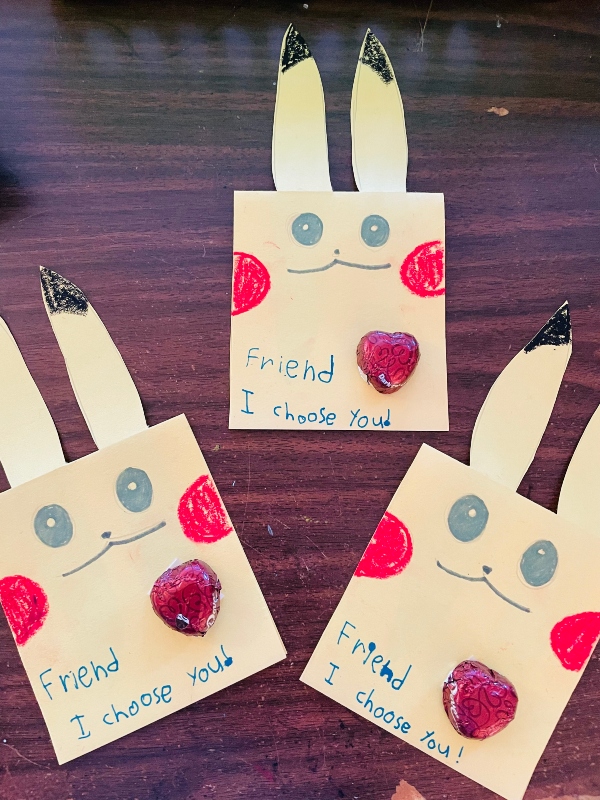
                Valentines made by my son for his classmates
                (idea found online)

                Valentines made by my daughter for her classmates
                (idea found online)

                * * * Random photos incoming * * *

                A meal at a Persian restaurant

                Signs of spring in the neighborhood-
                cherry blossoms

                Also in Feb--
                • I reconnected with a bunch of college friends- there is a reunion in the making. It is great to start chatting again like no time has passed at all. (In reality a LOT of time has passed since I was in college)
                • I watched a production of The Vagina Monologues- I have seen it a few times before but this production was special because a close friend of mine was in it. Like others in this production, she isn't a professional actress. She is a graphic designer and a mom. She was SO GOOD!! It blows me away how much talent is among us. If you ever get a chance, don't miss this show. Every time I have seen it, I have laughed and cried and come away empowered.
                • I ran my first 5K in a few years. The course was frustratingly hilly (as is every course in our wonderful town) and I was just thankful to finish without puking or passing out. I posted a decent time- better than I expected- considering that I really started running regularly last month. I'm motivated to keep at it. Say what you will about running but it is a very efficient workout. Even better, I now have a running buddy who I run with most weekends. She elevates the whole thing for me. 
                Your turn: Tell me your highlights of February.