Monday, May 26, 2014

Summer Reading (Board Book Edition) and Summer Eating

Pasta with raw tomato sauce, and our favorite board books for toddlers.

Today is Memorial Day here in the US, a day of remembrance and also the unofficial start of Summer- my favorite season. Something just feels different about Summer, and I don't mean the sweat trickling down my back in too-hot Georgia.. Summer is lazy and laid back, a pause between semesters. A time for casual meals featuring fresh produce and juicy watermelon, preferably while reclining on a picnic blanket under a shady tree.

The other fun thing about this season- summer reading. Our public library hosts a summer reading program every year. We enjoy books all year round but I get excited about this anyway. I'm going to sign up Lila for the children's reading program. She's almost 3 years old this summer; the program is open for kids aged newborn to 11 years- emphasizing that it is never too early or too late to discover the magic of books. The goal is to read 10 books (or multiples of 10 books) over summer and you get your name on their wall of fame and a little sticker and stuff like that. You can read anything- it does not matter if the books are from the public library or just the books you already own.

In preparation for summer reading, I spent a few minutes organizing Lila's books and decided to chronicle some of her current favorites here. These are just the board books I'm talking about today- we prefer them because they don't tear easily and can stand up to handling by a toddler.

I counted about 50 board books in Lila's library ("liberry").  Most of these are gifts from generous friends and relatives. Several are finds from yard sales and thrift stores. And of course we buy her books now and then.


Baby Talk. When Lila was only a few hours old, and she and I were still in the maternity suite of the hospital, a volunteer stopped by from an organization that promotes reading to kids. She gave newborn Lila this book and gave me a little card that explained how reading is one of the greatest gifts you can give your child. So this was the first book that Lila was given in person. "This little baby is hiding. Peek a boo" This sweet and simple book is a favorite and almost falling apart from years of over use.


We've come to love some authors/illustrators.


Sandra Boynton's characters are hilarious and the books are whimsical. In Blue Hat, Green Hat, different animals wear the same article of clothing, except the silly turkey who wears socks on his arms and pants on his head. You may or may not chuckle at this but it is downright ROTFL stuff for the toddler set.


Eric Carle's vibrant and textured collage art is beloved and unmistakeable. From Head to Toe is a book that gets a child moving (and identifying body parts) as they mimic different animals: "I am a gorilla and I thump my chest". In The Very Hungry Caterpillar, the caterpillar eats chocolate cake, ice cream, pickle, cheese, cupcake, cherry pie, sausage and watermelon all in one Saturday. Don't tell me you've never fantasized about doing this yourself. Spoiler Alert: The caterpillar got a stomach ache.


Lois Ehlert's illustrations have saturated color and often depict nature. We love identifying fruits/veggies and flowers in Eating the Alphabet and Planting a Rainbow. She has also illustrated the classic alphabet rhyme Chicka Chicka Boom Boom by Bill Martin Jr. and John Archambault where the alphabets gather at the top of the coconut tree.


Another favorite illustrator is Lucy Cousins, the creator of adorable Maisy mouse. In Maisy Plays, we see Maisy painting, splashing and hugging panda.


We are one of the millions of Dr. Seuss fans. A couple of favorites are Oh, The Thinks you can Think ("Oh, the Thinks you can think up if only you try.”), Hop on Pop (V likes this line, "STOP You must not hop on Pop."), and Mr. Brown Can Moo, a book of wonderful noises.

I found a cute idea online: Get a copy of Dr. Seuss's Oh, The Places You'll Go and have all your child's teachers write a note in it (secretly) when the child moves to the next class. Then give them the book when they graduate high school, with messages from all their teachers over the years. I've started one such book for my little girl.

Some yard sale treasures that have become favorites: 


How do Dinosaurs Count to Ten by Jane Yolen and Mark Teague. "Now that he's counted from one to ten, how does a dinosaur count again?"


Five Little Monkeys Jumping on the Bed by Eileen Christelow was the very first book that fully engaged Lila. When she couldn't talk yet, she was wagging her finger and cooing on cue at "No more monkeys jumping on the bed". The repetitive, rhyming story is very effective.


Jamberry by Bruce Degen is a rollicking berry picking romp. "Under the bridge, And over the dam, Looking for berries, Berries for jam".


Lift-the-flap books provide interactive fun for little hands. Where's Spot by Eric Hill is a favorite. Spot's late for his meal and his mom goes looking all over for him."Is he in the piano?"


I call this set the lovey dovey books. They are excuses to snuggle and cuddle your child. In The Runaway Bunny, baby bunny makes plans to run away from home and mama bunny finds a way to reach him wherever he is. Won't you be my Kissaroo chronicles the day's kisses from morning to night.


Books about sleep and bedtime are quite useful in nudging a reluctant toddler to get ready for bed. They provide a nice way to wind down for the night. In the zen-like Goodnight Moon by Margaret Wise Brown, a little bunny prepares for bed by saying good night to everything in his room and outside his window: "Good night, stars. Good night, air. Good night, noises everywhere."


Lila's oldest cousin (who is in her 20s) gave her a pile of books that were her own childhood favorites. These are timeless classics and we enjoy them so much. Go Dog Go by PD Eastman has dogs headed for a party on scooters, skis and cars. "Stop, dogs. Stop! The light is red". Lila loves chanting the words when we're at a stop light. Hand, Hand, Fingers, Thumb by Al Perkins has a cast of monkeys and drums: "One hand Two hands Drumming on a drum".


I am always blown away by the wisdom and depth of some children's books. This is one: Beautiful Oops by Barney Saltzberg. The message is that it is OK to make mistakes, in fact, mistakes are an opportunity to be creative.


Most of our board books only have a few words or a line or two of rhymes. This is one of the first which features an actual story: Sheila Rae's Peppermint Stick by Kevin Henkes, about two sisters and one peppermint stick- will they share it?


Nursery rhymes are ever-popular- they bring classic rhymes to life with pleasing illustrations.


And while illustrations are lovely, young children also like looking at real-life photos of objects and people. We have one favorite book about trucks and several about words and alphabets.


Zoe and her Zebra by Clare Beaton was a birthday gift and I love it so much. It is a unique book with art work stitched with felt and embroidery, embellished with beads and buttons. And the characters are multicultural.


My favorite source for book resources for children is the Saffron Tree blog- here are their 10 beloved board books. Playing by the Book is a blog of children's book reviews and clever and fun activities to do when you read the book. And via Niranjana, I heard about Open Library. No matter where in the world you live, you can sign up with your e-mail address and borrow tens of thousands of e-books to read.

So far, Lila has only been reading books from her own library. I was too apprehensive about library books being chewed on or messed up with sticky fingers. But now I am confident that (a) she is able to be careful with books and (b) she likes reading new books and not just the same ones over and over, and this week I checked out three board books to kick off summer reading. Do you have any board books/ toddler books to recommend? 

From reading to eating: here's a summery pasta with a raw pasta sauce, very similar to this recipe I've posted before. It takes minutes to make and is just perfect for hot weather.

For about 4 servings:

Bring water to boil and cook 1/2 package (about 1/2 lb, 4 servings) pasta. I used whole wheat angel hair. Cook until just tender.


In a large bowl, mix and marinate while the pasta is cooking-
  • 3 ripe tomatoes, diced
  • 1/4 cup (or so) olive oil
  • 1 tbsp. balsamic vinegar
  • Salt and pepper to taste
  • 1/4 cup cashew powder
  • 1/4 cup chopped olives
  • 1 clove garlic, minced
  • Basil (paste or minced leaves)
  • Sprinkle of oregano
  • Pinch of red pepper flakes (optional)
 Drain the pasta and add it to the raw pasta sauce. Toss, add some grated parmesan cheese if you like and serve.

Do you have anything fun planned this summer?

Monday, May 12, 2014

Waffles with the Works

Last year for my birthday my husband bought himself a waffle iron. True story. He then used it to make me waffles for a celebratory birthday breakfast, and it was a weekday and all, so that took some planning and recipe-googling. It actually was a really nice way to start the day. After I had eaten my waffles, I did narrow my eyes and say, "Well played, Sir, well played" because while I have a take it or leave it relationship with waffles (and thus have never cared enough to buy a waffle iron myself), V loves them.

I can't say we've ever made weekday waffles since that birthday morning. But we regularly pull out the waffle iron when friends come over for brunch and set out a build-your-own-waffle bar. It has high crowd pleasing potential for not a lot of effort.

If you ask me, the perfect waffle should be crispy on the outside, tender on the inside and light as a feather. We tried out a few recipes before we found the perfect one in Mark Bittman's How To Cook Everything. It is a overnight waffle which makes early morning entertaining that much easier because you do most of the work the night before. Not that I'd call mixing a bunch of things "work". The trick is that these waffles are yeasted. The yeast works overnight to make light and tender waffles scented with the aroma of fresh bread. I changed the recipe a little to add some cornmeal and it makes them even more crispy and flavorful.

Yeasted Overnight Waffles
(Recipe adapted from Mark Bittman's How To Cook Everything)

1. In a large bowl, mix
  • 1 and 1/2 cups all purpose flour
  • 1/4 cup coarse cornmeal
  • 1/4 cup whole wheat flour
  • 1/2 tsp. instant yeast
  • 1 tbsp. sugar
  • 1/2 tsp. salt
2. To the dry ingredients, add in this order and mix
  • 2 cups milk (I use whole milk)
  • 1 stick (8 tbsp.) butter, melted
  • 1 tsp. vanilla extract
3. The batter will be loose. Cover (not airtight) and let the batter rise at room temperature overnight.

4. When you are ready to make waffles, separate two eggs. Stir in the yolks into the batter. Whisk the whites to soft peaks and fold them gently into the batter.

5. Make waffles using some oil on the waffle batter. We get better results when we let the waffles for bit longer to let them get crispy and golden.

Notes:
1. By the way, once when we had guests who wanted to avoid eggs, we used ground flaxseed in place of the eggs and the substitution worked quite nicely.
2. These waffles freeze well too.

The waffles themselves are not sweet. We tend to set out some of these toppings:
  • Peanut butter and other nut butters
  • Jam or preserves
  • Maple syrup or honey or agave nectar
  • Salted caramel sauce
  • Chocolate sauce
  • Whipped cream
  • Berries and other fresh seasonal fruit
  • Butter
  • Ice cream (in which case the waffles are officially the dessert course)
V's favorite waffle combination: crunchy peanut butter, honey and sliced bananas.

I'd really like to try a savory waffle sometime. I've even seen waffles with idli batter. Do you make pancakes or waffles on weekends? 

For this birthday, V did not get a kitchen appliance, either for himself or for me! He got me an iphone so I can retire my 7 year old flip phone, and hence join the 21st century, I suppose.

Have a great week, friends.

Monday, May 05, 2014

Kale Pesto Pasta Salad, and How to Make Time

This blog is mostly about food and sometimes about books and crafts. I often get e-mails from readers, and the funny thing is that these e-mails are rarely about recipes or books or crafts. (Although I do get asked all the time what brand/model food processor I use). People want to know how I find the time to cook and read and indulge in my hobbies and blog. And it is a question that I never have a good answer for.

Image: Goodreads
I just read a book that talks about this: Laura Vanderkam's 168 hours: You Have More Time Than You Think. Vanderkam thinks of a person's life in terms of weeks. Each week has 7 days times 24 hours equals 168 hours. That sounds like quite an impressive number of hours. So when weeks fly by in a blur, where exactly does the time go? Why is it that different people do dramatically different things with their lives even though everyone has the same 168 hours each week? Is there a way to fit everything that you want to do into these 168 hours? Here is what I took away from this book:

Chapter 1: The Myth of the Time Crunch. Vanderkam points out that we live in a culture with a strong narrative of overwork and time starvation. I agree with this. It is a mark of success to be harried and exhausted and over-scheduled. We vie with each other to say that we worked the most number of hours per week and that we have 5 meetings back to back. When I chat with a friend, the first thing we say to each other is, "How are you? Oh, super busy, you know. Things have been pretty crazy". But sociological data shows that we overestimate time spent on work and housework and underestimate time spent watching television. Vanderkam suggests that we start with a blank slate of 168 hours and very honestly and meticulously fill in how we spend our time.

Here's what she says about not doing something that you want to be doing. "...it is a choice, and not a matter of lacking time. When you say, "I don't have time," this puts the responsibility on someone else: a boss, a client, your family. Or else it puts the responsibility on some nebulous force: capitalism, society...regardless, the power slips out of your hands". Bottom line: there is plenty of time if you make good choices about how to spend it.

Chapter 2: Your Core Competencies. Know what you are good at and what you can do better than almost anyone else. Those are your core competencies and you are likely to do well in life if you spend more time focusing on them. Study your time logs and figure out exactly where you are spending your time and whether you're spending enough time on your core competencies.

Try lots of different things that you think you might enjoy to help you identify what you are actually good at. She gives an example of someone who told herself that she would love to sew if only she had the time. One day she took the plunge and took a sewing class and did not enjoy it at all. At least now she knows to cross that dream off her list and devote her mental energy to other things. Instead of just dreaming of doing something, try it in a small way and see if it actually feels enjoyable or not. "There is extraordinary power in knowing what you want to be doing with your time. When companies execute with this clarity of strategic intent, they thrive. When people do, they thrive too".

Chapter 3: The Right Job. "We spend a lot of our waking hours working...Like choosing the right spouse, being in the right job can give you amazing energy for the entirety of your 168 hours".

Chapter 4: Controlling your Calendar, Chapter 5: Anatomy of a Breakthrough. These chapters are about working smarter and in a more focused, results-oriented way rather than filling time with pointless meetings and conference calls, say. "Do not mistake things that look like work for actual work". Most of the advice is geared towards people who want to climb the corporate chain, make business breakthroughs, gain that coveted corner office. But it is adaptable to other situations as well.

Chapter 6: The New Home Economics and Chapter 7: Don't Do Your Own Laundry. The circumstances and realities of each person's life are different. The author's background is very affluent and there were things in this book that were very jarring for me. You see, Vanderkam's strong advice is to outsource housework. Laundry, cooking, cleaning and other "unnecessary domestic burdens" "take time away from activities that are among your core competencies" and should be avoided by hiring someone else to do them. Her solutions are breezy and one-dimensional- Spending too much time cooking? Hire a personal chef. Vanderkam's idea for those who don't like to wash dishes made me cringe: "...use paper plates and utensils, and then write a check to your favorite enviromental charity as atonement".

To be fair, I grew up in middle class India where having maids, cooks and gardeners was and is quite normal. The system works if we have two classes of people- the ones who make the big bucks and the one who earn small bucks doing menial chores. My own choice in this matter is to do my own damn housework my own damn self, thank you very much. (Well, we're two adults in the house so we split the housework.) How about living simply and mindfully, taking care of yourself and your home and teaching your children to do the same?

Now, I completely agree that it is all too easy to spend endless hours doing housework inefficiently. But chores can be minimized and streamlined and we try to find ways to do that. We buy easy-care clothing. We have a minimum of furniture and possessions and no knick-knacks that have to be dusted constantly. (A very good essay: the true cost of stuff). I make quick and simple meals that don''t dirty every pot and pan in the kitchen. We eat leftovers for lunch. Errands are grouped together. Shopping lists help to avoid frequent trips to the grocery store. To say that there are only two choices: (a) be stuck doing endless housework or (b) hire someone is incorrect.

Chapter 8: A Full Life. "...time is too precious for us to be totally leisurely about leisure". When we do get some time away from work and chores, we tend to fritter it away in the ways that are easy but meaningless- like watching TV shows that aren't even that enjoyable. Planned TV watching is different from aimless channel surfing. Instead, Vanderkam has concrete suggestions for making leisure time both enjoyable and meaningful:

1. Think of things you've always dreamed of doing and choose one or two or three activities or hobbies. Devote your leisure time to your chosen activities.

2. One of the activities you choose for your leisure time has to involve physical activity, because exercise is non-negotiable for good health. This one, by the way, was my biggest take home message/reminder from this book. I think I'm doing a fairly good job of using my time to create the life I want except that I'm consistently failing at exercising regularly. I really need to cut out my excuses in this department.

3. Align your time: Multitasking does not work, period. But Vanderkam talks about alignment where certain activities can be combined fruitfully, for instance, catching up with a friend at a playground while your kids play together or volunteering as a family. I definitely align my TV time and crafting time and enjoy both simultaneously.

4. "Use bits of time for bits of joy". Have a few enjoyable activities for small (10-30 minute) chunks of time, like keeping a book in your car to read while you're waiting to pick up your child at school, or writing poems or letters while commuting in the subway.

Chapter 9: The Hard Work of Having it All. The author does a couple of "time makeovers" here and has tips to do this at home by logging one's time, creating a list of dreams, identifying one's competencies and devoting time to them, ignoring and minimizing things that you identify as time-wasters, and checking in with yourself regularly to see if your weeks are looking the way you hoped they would.

All in all, this book has quite a bit of interesting content. It makes me very sad when people tell me they would like to do something but they just can't find time for it. Life is too short, time does go by and it is indeed a pity if we just dream of doing things (big and little) and never get around to doing them.

I recently had a sort-of milestone birthday. The kind where even though I know that age is just a number and yadda yadda, I couldn't help feeling a teeny bit shocked- I'm HOW old?- and more importantly, I had to ask yourself: What am I doing with my life? I'm raising a child and caring for a family and while I hardly have a high-profile career, I have a humble but very rewarding part-time job. But look at the world around us- there's so much injustice and inequality. We cannot just be thinking of our own families and our career moves. I have the benefit of being educated and financially secure and I want to be doing much more with my time and with my life. (I sincerely hope the previous sentence does not end up as an empty sentiment on my blog.)

I'll leave you with this quick recipe that I tried yesterday- a pasta salad much like this one I've posted before, but with a fresh kale pesto. There's some controlled multi-tasking in this recipe!

Kale Pesto Pasta Salad

1. Roast the veggies. Preheat oven to 400F (convection setting if your oven has one). Cut assorted vegetables into bite size chunks (I used 2 zucchini, 2 red/orange bell peppers, 1 box of mushrooms). Toss with salt, pepper and olive oil and roast until tender and slightly charred on the edges.

2. Boil and drain the pasta while the veggies are roasting. I used 3/4 of a box of whole wheat shells.

3. Make the pesto while the pasta and veggies are cooking.
a) Boil a small pot of water. Add roughly chopped kale (1 bunch) to the boiling water for 2 minutes. Drain.
b) Roast 1/2 cup walnuts for a minute or two in the microwave.
c) Blend the blanched kale, walnuts, 1 tbsp. nutritional yeast, basil (fresh/paste/dried), 2 glugs olive oil, 1 tbsp. balsamic vinegar, salt and pepper to taste in the blender to a smooth paste.

4. Toss the roasted veggies, cooked pasta, pesto together. Optionally, add jarred olives or artichokes. Taste and season with salt and pepper if needed.

This dish is wonderful hot, cold or at room temperature. Perfect for lunch boxes and picnics. Happens to be vegan. Rice or quinoa would work well in place of the pasta. Or simply skip the pasta and use the pesto-veggie mixture as a sandwich stuffing. Possibilities!

Is this time management stuff giving you a massive headache? Do you feel like you have time to do the things you love doing?

Monday, April 28, 2014

The List: April 2014

April was a glorious month- yes, it was my personal worst allergy season of all time (I discovered for the first time how scary it is to be so congested that one is gasping for breath; let's just say I have much empathy for people with asthma) but all that was outweighed by the fact that my sister and her family came to visit. Two little cousins met for the first time and spend 10 days playing, singing, dancing, squabbling over toys, splashing in a little wading pool (best 15 bucks I ever spent), and visiting every playground in a 10 mile radius.

Cooking and Baking

Farmer's Market season is on and we went one sunny Saturday morning. I was thrilled to find Spring garlic- do you know what that is? It is just like Spring onions, but the shoots come from garlic rather than onion. The taste is subtle and garlicky- sounds like a contradiction but really that's how I can best describe it. In India, we'd get this every once in a blue moon and my aunt and I made scrambled eggs with it. This time I used it in a veggie and omelet noodle stir fry. I still think scrambled eggs are the simplest and best way to showcase this seasonal specialty.


This was a long-bookmarked recipe- brussels sprout fried rice from Post Punk Kitchen. I added heaps of vegetables and only a modest amount of rice. And crushed peanuts instead of cashews. So delicious! The coconut oil really does add a nice touch to this dish.


A friend e-mailed me a recipe for no-bake energy bites. Well, basically these are mini ladoos made with raw oats, peanut butter, honey, coconut, flaxseed, chocolate. You just mix a bunch of ingredients and form small balls. I tested the recipe on my colleagues at a work meeting and they gave it two thumbs up. Lila also gave it a metaphorical thumbs up- her fingers and thumbs were busy stuffing two ladoos in her mouth simultaneously! Here's the recipe.


And carrot cake. It was not too sweet, moist and just about perfect. Instead of a 9 x 13 sheet cake, I made 2 circular 9 inch cakes and froze one for another occasion a couple weeks later; it thawed beautifully. I'm always happy to find freezer-friendly recipes.


Reading
Image: Goodreads
I read an exceptional book this month- The Emperor of All Maladies by Siddhartha Mukherjee. The author is a cancer physician-scientist who happens to also be a gifted storyteller- a rare and wonderful combination. He narrates the story of cancer from the very beginning, weaving in history and biology, medicine and politics into a masterpiece.

This is a work of non-fiction with more twists and turns than your average detective story- I breathlessly read it in three or four evenings. Parts of the book are dense with biomedical jargon which might not be a breeze if you don't work in biology/medicine (I do and I thought he handled complex concepts very well) but truly, this book is worth a read. Because I'm betting that this terrible disease has affected most of us in one way or another and it is worth learning more about where we are and where we came from, vis-a-vis cancer.

Also, I read this thoughtful piece of reporting: India's Golden Chance.

Watching

Breaking Bad. This show is- how should I put this- a wee bit addictive. I'm watching 2 episodes every night. Thanks, R. ;)

Jim Gaffigan's Mr. Universe stand-up hour on Netflix. My sister and I were looking for something genuinely funny to watch one evening and this was it.

Making

Some months ago, I made a laundry detergent concentrate ("laundry sauce") using an online recipe and was pleased with it for the most part. Last week when I ran out, I made detergent again, this time liquid- well, it is more of a gel- laundry detergent using this recipe. It made 5 gallons- enough to fill one of those orange pails from Home Depot!


My bag-sewing skills got a boost with a pattern that I bought from my local quilt shop: It is called the two hour tulip purse from the designers at Anything but Boring. A gratifyingly well-written pattern and it makes a cute lunch bag/ around town purse. I made one in a cheerful Springy print for a dear friend.


I have to show you a couple of cute things sewed by my sister- unlike me, she doesn't need no stinkin' patterns. Her designs are all original.


A kitty backpack for Lila- it is adorably toddler sized.


A placemat for Duncan- because no dog should be without a personalized placemat.


What have you been eating, cooking, reading, watching, making this month? Anyone else doped out on anti-histamines? You have my sympathies. Happy May!

Sunday, April 20, 2014

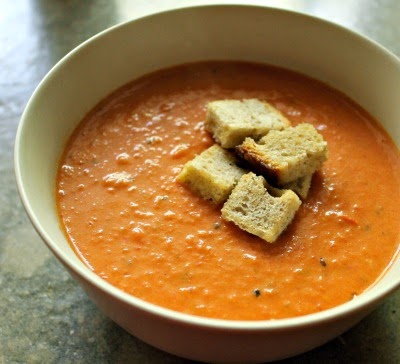
Creamy Tomato Soup with Croutons

Do you use your cookbooks much? I've come into several interesting cookbooks in the last few months- some are gifts and some are review copies. I read them like novels from cover to cover as soon as they fall into my hands, but somehow never get around to cooking from them. When it comes to looking for a recipe, I seem to reflexively start typing search terms into a web browser rather than hitting up the cookbooks.

So I went through my recently acquired cookbooks and bookmarked (I mean, actually bookmarked with little bits of paper- imagine that) a few interesting recipes to try. The hits will find their way to the blog, of course.

Today's recipe comes from a book called Copykat.com's Dining Out At Home Cookbook 2: More Recipes for the Most Delicious Dishes from America's Most Popular Restaurants by Stephanie Manley.

Manley has been posting recipes on her website copykat.com since 1995- that's positively historic in Internet years, isn't it? In the introduction to the cookbook, she says that the website started as a way to store family recipes and capture food memories, like the one of eating her grandmother's sauerkraut: "Her sauerkraut was homemade, meaning she made it from cabbage, salt and time".

Manley's "thing" is to replicate recipes from restaurants. I can so relate to this. I love eating out- always have. As a teenager I ate my way through all the iconic foodie addas of Bombay. Cooking for myself (and later for myself and my small family) in the US, eating out is a more or less weekly break from the routine. And restaurant meals are my biggest source of inspiration to try new ingredients, flavors and techniques in my home kitchen.

In all three states we've lived in, in the US, we tend to seek out small local places rather than the chain restaurants. This doesn't have a whole lot to do with snobbery. It is more that chain restaurants seem to have precious little in the way of meatless options. We have better luck with the family run "ethnic" restaurants- Thai, Mexican, Ethiopian- and some of the eclectic local ones like vegetarian diners. When I have the option of supporting a local business, I'll choose that any day. But I do realize that in vast swatches of the US, fast food and chain restaurants are sadly the only choices for eating out.

So it was astonishing to look through the restaurants covered in this cookbook and realize that after 15 years in this country, I haven't stepped foot even once at any of the "big" chains like Chili's, Dairy Queen, The Cheesecake Factory, Olive Garden or T.G.I Friday's. I've never had a drink from Starbucks- surely the only person in North America not to have chugged a whatchamacallit. My experience with fast food and casual dining is woefully limited. When I am someplace with only fast food choices, I try to find one of two places. Either a Subway- they have a veggie patty which I load with veggies (lots of spinach, never lettuce), and smother in southwest dressing and it is OK. Or a Chipotle, where I get the crispy tacos and the hottest salsa they have, which is pretty hot. I've eaten a Taco Bell veggie burrito at some airport once. And on rare trips to the mall in St. Louis, we would grab lunch at California Pizza Kitchen- they had a decent white bean hummus. In St. Louis, we lived a few blocks away from a Qdoba and I liked their taco salad every now and then. It is served in a huge crispy shell, so what's not to love? And of course there was also a St. Louis Bread Company nearby. That's a chain that started in St. Louis and everywhere else, they're called Panera Bread but in STL, they kept the original name. Here in town, I took my parents to an IHOP once and can't say I was impressed by anything other than the massive portion sizes.

Chain restaurants are as popular as they are because they are quick and convenient. They use the power of salt, sugar and fat to make food as appealing to as many people as possible. And these menus often have eye-popping items that are just way over the top: there's a Katz's Deli cheesecake shake included in the book where you blend a slice of cheesecake and vanilla ice cream into a shake. Who comes up with this stuff? The point is, if you can find a way to make a restaurant favorite at home, using fresh and whole ingredients as much as possible, that can only be a good thing and a welcome addition to the meal rotation.

Manley's copykat cookbook is simply written- there are no pictures, only text recipes. Recipes are well-written and easy to follow. The format is tidy, covering all courses of the meal, and there are helpful icons to indicate recipes that are make-ahead, for instance, or good for game day. There's a section for favorites like Red Lobster's Cheddar Bay biscuits- even I've heard of those. Manley tries to use "real" ingredients as much as possible but she's a fan of these restaurants and she's replicating recipes as closely as possible, not judging them or making healthy versions of them.

Overall, this is a very fun cookbook. Among the recipes I've bookmarked to try: TGI Friday's Mediterranean hummus with a bruschetta topping, Benihana's fried rice, Olive Garden's salad dressing and a strawberry shortcake. The one I tried this afternoon is Creamy Tomato Soup, a copykat of the one at Panera Bread.

I distinctly remember eating this soup for a quick lunch at Panera Bread (well, it was called St. Louis Bread Company) while walking back from the library with infant Lila strapped to my chest, one of her first outings into the world. It is a very rich and comforting soup and Manley's fool-proof recipe got the flavor just right for me. If you've in the mood to make a thick and rich restaurant-style tomato soup at home, this one is worth a try. Last time Lila was too young to taste the soup; today she happily ate two bowls of it.

Creamy Tomato Soup
(In the style of the creamy tomato soup at Panera Bread; 
recipe adapted from Copykat.com's Dining Out At Home Cookbook 2 by Stephanie Manley)

1. Heat 2 tbsp. butter in a large pot.
2. Saute 1 medium chopped onion and 3-4 cloves garlic, stirring so that garlic does not burn.
3. When the onion is translucent, add 2 tbsp. flour and stir for a couple of minutes.
4. Add 1/2 cup whole milk and stir until the mixture thickens.
5. Add 1/2 cup cream, a pinch of baking soda, 2 tsp. sugar, 1 tsp. salt, pepper and red pepper flakes to taste, 1/2 tsp. dried basil and 1/2 tsp. dried oregano.
6. Add 1 28-oz can of tomatoes (I used unsalted peeled whole tomatoes).
7. Use an immersion blender to blend the soup to a smooth consistency.
8. Simmer on low heat for 15 minutes. 

Note: You could add 1 cup half and half instead of 1/2 cup each of milk and cream.

I served the soup with croutons made simply by tossing cubes of stale bread in olive oil and oven-toasting for 10-15 minutes at 300F until crisp.

Are you a fan of chain restaurants? What restaurant recipes would you most like to replicate?

Disclaimer: I was sent a review copy of Copykat.com's Dining Out At Home Cookbook 2 by the publisher, Ulysses Press. I received no monetary compensation and all opinions expressed in this review are my own.

Tuesday, April 01, 2014

The List: March 2014

Whoa, where did March go? Marched right past me when I wasn't looking.

Making
My very favorite project this month was a mini art gallery for my little one's artwork, brightening up a corner of our dining room. When I asked Lila one morning what she wanted to do in school that day, pat came the answer, "I want to do potty and painting with Miss K". Umm- OK. Toddlers are so hilarious and random. But she is in fact a prolific artist and like most toddlers, we are sent home with heaps of sheets covered in exuberant finger painting and paper pasting.

If your child comes home with artwork, what do you do with it all? I'm not one to reverently preserve every scrap of art that comes home. Dusty cartons filled with years of artwork- I don't want to collect that and then saddle my kid with it. My plan is to actively enjoy and use up the artwork: I'm saving a select few (very few) in a folder to keep. Some end up in the recycling bin. Most of the rest I use up- by cutting them up and making note cards, thank you cards and gift tags. With many paintings, I simply write a letter/note on the back and mail them off to relatives and friends: a get well soon note to a grandpa, a good luck letter to a cousin for her exams, a hello note to an friend. I figure it is fun to get cheerful toddler artwork in the mail among the usual pile of bills and catalogs.

And finally, I wanted very much to display some of Lila's paintings on our walls because that's what it is- a unique and original work of art. A child's creation is as legit to me as anything in an art gallery.

The idea for these frames came from here. Here's a quick run down on how I made these:
1. Buy wide frames. These are from yard sales and thrift stores (they cost like 25 cents each). Trash to treasure, baby.
2. Remove the backing, glass, any staples etc. from frames. You only need empty frames. Wipe them clean.
3. Spray paint them. I did this outside.
4. When the frames are dry, paste magnets to the back corners of the frame with double sticky tape. Sheet magnets did not work for me. I bought something called Darico super strong ceramic magnets from the craft store.
5. Use more magnets to hold down the artwork. This way it only takes a second to switch out the artwork when the kid comes home with new creations.

I have some spray paint left so I might make more frames to add to the gallery.


In Lila's school, parents are asked to bring in a dozen filled eggs for the Easter egg hunt and non-candy fillers are encouraged. Last year I put in stickers. This year, I used some felt that I had on hand and made chick finger puppets; the inspiration is from here.


A quick sewing project: I made an envelope pillow to coordinate with Lila's quilt.


Baking and Cooking
Sour cream banana bread. I used this recipe- and to quote the blogger: "Speaking of ripe bananas, you will have your best banana bread if you use dead black bananas. They should be entirely black, and maybe with a couple of little fruit flies lazily circling them." Good point!


Lentil shepherd's pie using this recipe, but I needed to use up potatoes so I subbed them for the sweet potatoes. Good but not all that special.


This was one of the best meals this month, and took me about 10 minutes to put together.

The khichdi- equal parts rice and vaal dal (yellow moong dal would work as well), rinse, add water and a generous dollop of bisibele masala paste, pressure cook.

The subzi: tiny cubes of potato and butternut squash with mustard seeds, cumin-coriander, salt, turmeric, chili powder, pan fry until tender, garnish with cilantro. And yes, that is a puddle of molten ghee in the picture.

Reading Neil Gaiman's Coraline, a quirky story about a child who wanders into a world that is a sinister mirror image of her own.

Apart from the books I already wrote about, my favorite book this month was Home Cooking, a collection of essays by Laurie Colwin. So warm and funny. This one is a must-read. And it contains some good recipes too: I want to try baking the gingerbread and black cake.

I also started reading Castle Waiting by Linda Medley and Haunting Jasmine by Anjali Banerjee but neither held my attention and they were abandoned. I figure life is too short to make myself read books that I don't find interesting.

Watching the series finale of How I Met Your Mother, a show I've watched on and off for many years. Also watching Midsomer Murders on Netflix. One Saturday afternoon this month I watched PBS for 5 hours straight and oh, it was glorious. First, there were a couple of food shows with some recipes that I will have to try soon, like a tres leches cake on Cook's Country, then Priceless Antiques Roadshow which is always so entertaining and that was followed by a documentary on British sitcoms.

What have you been cooking, eating, celebrating, making in March? Happy April! I have family visiting this week and there's much to look forward to.

Tuesday, March 25, 2014

Books Bringing History to Life

Spring Break had me on a reading binge so while I haven't really cooked or baked anything special, I've spent many evenings curled up on the sofa with a stack of books.

History was my least favorite subject in school. Except maybe for PT (physical training) which was downright horrible, thanks to my inherent couch-potato-ness and the ill-tempered PT instructor Miss Ruby. But anyway, history class was tedious and I struggled to get it over with so I could get to the fun subjects like English and Biology. I wretchedly memorized seemingly random dates and wars and treaties without any context to what I was being made to learn.

It is only now, decades later, that I feel like I am re-learning history bit by bit, through books that are not history textbooks at all. Instead, they are novels set in particular historical periods, or mysteries set in foreign lands, or memoirs from a particular era. And thus, through the art of story-telling and the formation of an emotional connection, I am finally beginning to understand historical events and how they relate to politics and world events today. Here are three books I read last week, each of which provided a better history lesson than any textbook could.

Image: Goodreads
I have enjoyed all of Jhumpa Lahiri's books, especially her short stories, so I got into a months-long virtual queue at the library to get my hands on her latest novel, The Lowland. It has all the classic Jhumpa Lahiri features- roots in India, a move to the North-Eastern US, culture clash and a search for identity. All this is woven into a family saga spanning three generations.Two brothers grow up inseparable but their lives branch out as one gets entangled in the Bengali communist party and the dangerous and radical politics of the Naxalite movement while the other brother stays in the safety of academia and moves to the US. I've heard the word "Naxalite" hundreds of times without understanding at all what it was all about. This novel explained a great deal of the history and politics behind that movement. The story, however, was too heavy and sad. The characters too unwilling to change their situation. An emotional read, but I just wish the emotions were not all oppressively negative.

Image: Goodreads
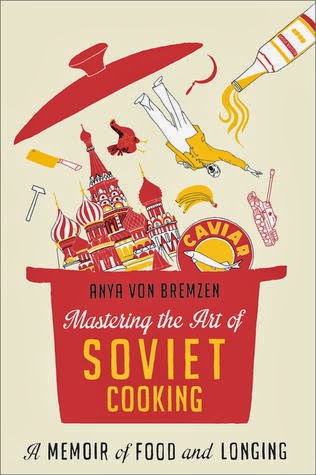
Communism is also front and center in Anya Von Bremzen's Mastering the Art of Soviet Cooking: A Memoir of Food and Longing. The title is rich with irony, and the book is a highly personal, searing and funny romp through nearly a century of life in Soviet Russia- in Bremzen's words:  "All happy food memories are alike; all unhappy food memories are unhappy after their own fashion...Inevitably, a story about Soviet food is a chronicle of longing, of unrequited desire. So what happens when some of your most intense culinary memories involve foods you hadn't actually tasted? Memories of imaginings, of received histories; feverish collective yearning produced by seventy years of geopolitical isolation and scarcity..."

This book made me so nostalgic. You see, a few decades ago, India and Russia were socialist allies with a great deal of so-called cultural exchange: Russian book fairs in India and Hindi movie stars idolized in Russia, that sort of thing. The newspapers were full of mentions of Gorbachev's glasnost and perestroika. I grew up with Russian children's literature and a subscription to a Russian magazine called Misha. And their books and illustrations were quite rich and fantastic and very un-Disney if you know what I mean. The Adventures of Dennis (there was no menace with this Dennis, mind you) was my favorite Russian-translated book- and look, I found it reviewed here. My parents who are not known for throwing away things probably still have it. I remember a story where young Dennis asks his friend, "What are your favorite things?" The friend answered with a long list of irresistible food items that goes on for two whole pages. After this breathless menu recitation, the friend asks the same question to Dennis who says, "I like kittens. And grandma". Such a funny-sweet-sad story of children who know quite a bit of hunger and scarcity. Bremzen's memoir explained exactly what the country was going through to produce a story like that.

Mastering the Art of Soviet Cooking has a whole chapter on the favorite Soviet celebratory dish Salat Olivier or what I knew as my mother's Russian salad- cubes of boiled potato, carrot, peas and pineapple chunks suspended in a homemade mayo dressing. Bremzen's book will be one of my favorite reads of 2014.

Image: Goodreads
War and unrest through a child's eyes. This theme comes to life yet again in the graphic novel, A Game for Swallows: To Die, to Leave, to Return by Zeina Abirached. The bold and beautiful black-white illustrations are a contrast to grimy, war-torn Beirut described in the book, which talks about a single evening in the life of young Zeina and her family and their neighbors, huddled from the bombing in the foyer of their apartment. Behind the anecdote was a history lesson in the 15 year long civil war of Lebanon. And by the way, for you time-pressed folks, this is a short graphic novella that you can devour in an hour or two.

This beautiful and touching book reminded me strongly of a friend in graduate school (we've since lost touch) who was born and raised in Beirut during this 15 year period. War was a fact of life for him; after all, he knew nothing else until he was a teenager. He told me that night after night, his mother would serve dinner during the ceasefire. When he moved in his teens to a place where there was no war, he wondered, "If there's no ceasefire, how do people know when to eat dinner?" I remember when he told me this, I felt such a pang of pain in my heart. Please can we stop waging wars?

That's three memorable books and I have several more that I'm looking forward to. What are you reading these days?

Monday, March 03, 2014

The List: February 2014

February may be the shortest month but around here it was an action-packed one with snow days and guests providing the most memorable moments.

Eating winter fruit salad- apples, clementines and dried cranberries. Rinsing the apple cubes in some lemon (or vinegar) water helped the salad stay fresh-looking even when I made it hours ahead of time.

The best things I ate all month: potato bourekas (baked puff pastry turnovers) made by my Israeli friend's mother and potato pierogis (doughy dumplings) made by a co-worker's mother using their traditional Polish recipe. Yes, it was the season of potato pastries made using old recipes by moms!


The most successful experiment of the month was lemon curd- a tangy and smooth dessert sauce. And the amazing thing is that this lemon curd is made in the microwave. The original recipe made a rather large batch and I wondered if I could cut it to a third. Dessert sauces can be a bit fussy and there's guarantee that fractions of recipes will work. But you know how I am- always living on the edge- and this time it worked. I cut it to a third for a smaller batch and it still worked beautifully and took 5 minutes tops.

Baking a berry yogurt cake. I used frozen berries because, well, have you looked out of the window? This is an easy, beginner-friendly cake and quite flexible- for instance, I used ricotta and homemade yogurt instead of milk and Greek yogurt, and subbed almond flour for 1/4 cup of the AP flour.

The lemon curd was whisked with whipped cream as a topping for this cake, and honestly the tangy lemon curd with the tangy berry cake did not quite work for me- too much tang all around. Next time I'll use them separately.

Making itty bitty hearts: A February list cannot be complete without a liberal sprinkling of red and pink hearts, can it? I made these tiny, puffy felt heart-shaped pins for her to give to her classmates for the preschool valentine exchange. The pattern is here on Purl Bee, but I used blanket stitch for edging.

Feb 14 is also International Book Giving Day and all the kids in Lila's class were asked to bring a gently used book from home to exchange with each other. Between valentine exchanges and book exchanges, it was a fun and busy day at school.

Sewing for superheroes: Our local domestic violence shelter gives out superhero capes to kids who come through their program as a way of offering them support and strength (and a bit of fun) during this very difficult time in their lives. They were looking for volunteers to sew some of the capes for them. I used this pattern and made a few. They provided us with this shiny, slippery fabric to make into capes. The stuff was a total pain to sew (it is not well-behaved like cotton) but after some teeth-gnashing I did get them done.

When 2 inches of snow/ice (what? don't laugh) brought life to a standstill for 4 or 5 days, a friend and her family stayed with us- they had issues with the heat in their house. We had to work overtime to keep the kids from going stir-crazy. I taught my friend's 6 year old daughter to sew and we made a little bunting. This kid impressed me with her patience and perseverance- especially since she speaks no English yet (only Hebrew) and I was teaching her using a strange language of gestures and nods.

Knitting a scarf/cowl- a gift for a friend. It looks like a shawl when worn but slips over the head and stays on without a fuss. The pattern is called Zuzu's petals and it was a joy to knit. If you've seen the movie It's a Wonderful Life, you'll remember the reference for Zuzu's petals.


Image: Goodreads
Reading Stephen King's On Writing. The first half of the book is a memoir of King's writing life- his childhood, his early fascination with pulpy horror movies, his earliest writing, his battles with addiction. The second half is a writing seminar with advice for aspiring writers: "If you want to be a writer, you must do two things above all others: read a lot and write a lot. There's no way around these two things that I'm aware of, no shortcut".
 I've read a couple of King's novels and I find them highly uneven- I love parts of them and the others drag on or seem outlandish (this is strange since millions of people clearly love his work.) But this book I did like from start to finish.


Enjoying the unique interaction between toddler and dog.

Lila's first chore- a daily task that she does almost every morning and evening since she turned ~2- is to feed Duncan. She picks up his bowl, walks to the closet where we store the food, V or I open the closet, then she scoops food into his bowl, asking "More?" after every scoop. We say "More please" and then "Bas" (hindi for enough). Then she closes the door, carefully walks back with the bowl and puts it in Dunkie's spot and tells him, "Enjoy your khaana, Dunkie" which is his cue to start scarfing down the food (khaana is Hindi for food.)

I am always amazed at how patiently Duncan will wait for as long as it takes Lila to do her thing- sometimes, spilling some kibbles, sometimes getting distracted for a minute with something else. But she does it- and takes pride in caring for and feeding a family member just as adults do for her.

Duncan finishes his meal in record time (seconds, literally), then comes back to find Lila. He does this unfailingly after every meal- walking to whoever fed him and sitting down next to them- it feels like a thank you gesture. And then he usually burps!

One Hot Stove will be on Spring Break next week and I'll see you in two weeks. Meanwhile, do share in the comments what you've been eating, cooking, baking, reading, watching, making and enjoying this February